
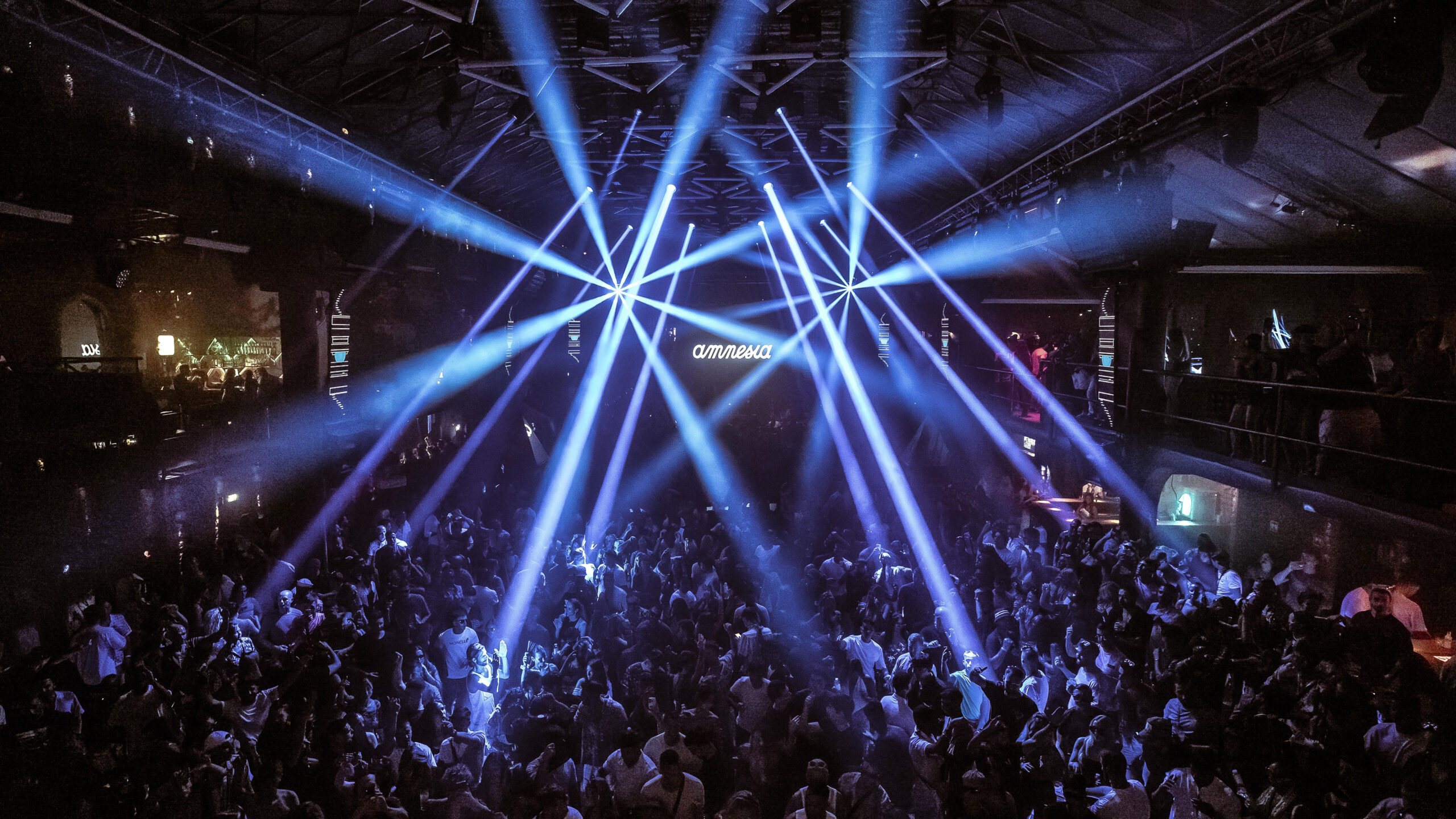
For this historic anniversary, I wanted to address you a little differently, dear Deep Tech Mag readers. Rather than simply offering you another retrospective on Amnesia’s fifty years, or only explaining once again why the club has become one of the temples of global nightlife, I chose another way in: my own.
That of a young clubber who arrived well after the golden age everyone talks about, nourished by archives, stories and fantasies of an Ibiza I never knew. With one question in mind: at 50, the Ibiza club continues to fascinate a generation that knew neither Alfredo, nor the birth of Balearic Beat, nor Cocoon’s greatest years. What if the golden age of partying was always the one we think we missed? I arrived at this club with the feeling that I was fifty years too late, I have to say it. Like many people from Gen Z, I already knew the club before ever setting foot inside it. I already thought I would never be able to go there one day because Ibiza did not speak to me at all. To be honest, I did not understand the hype until I found myself transported into another time and my preconceptions seemed to fall into oblivion too.
I had seen it in grainy archives, in documentaries, in the memories told by those who had known Ibiza before smartphones, before VIP tables, before DJs became superstars and clubs became superclubs. An era when, according to the stories of those who had partied before me, people came here to disappear for a few hours. So naturally, when I entered this almost sacred space for the first time, one question followed me: what can possibly remain of a place whose soul has been described to me so many times? Ibiza has changed a lot since then, but has Amnesia really changed that much?
A few hours later, stuck in the middle of a dense crowd under the lights of the Terrace, I had another one: how could it possibly have been better? Maybe Amnesia’s story is not the story of a golden age that disappeared. Maybe it is the story of several generations, each convinced in turn that they arrived after the best party there ever was.
First Generation: Leaving the World Behind for a Few Hours
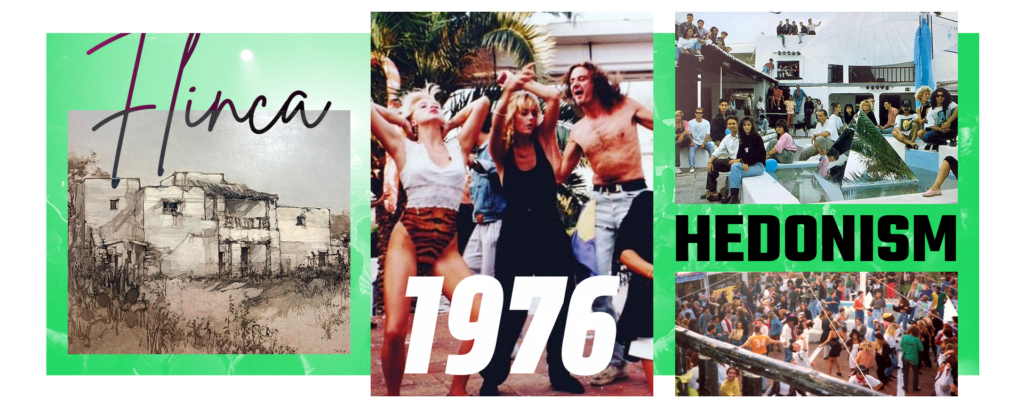
Before becoming a destination, Ibiza and Amnesia were first and foremost an escape. From the 1960s onwards, and especially during the following decade, while Spain was living through the final years of Franco’s dictatorship and then its democratic transition, Ibiza became a rather unlikely meeting point, a crossroads for all kinds of atypical people: European hippies, artists, travellers, outsiders, but also political exiles from Latin America. The island was a refuge for free thinkers and pleasure seekers. It was this search for hedonism that would shape the image of the island, but that would later be somewhat forgotten. I, at least, had carefully kept it in mind as an ideal I would never know. Maybe that is true.
I will never really know the old white finca on the road between Ibiza and San Antonio that opened its doors to dancing in 1976. At the time, Madrid philosopher Antonio Escohotado rented the place and imagined a space that he first called El Taller del Olvido: the Workshop of Oblivion. You entered for a few pesetas, beer included, danced in the open air courtyard around the old well of the house, covered by a glass pyramid, and some parties continued until the following afternoon. The place was imagined as an ideal for anyone who wanted to forget. For us, fifty years later, it is difficult not to remember it.
It may sound a little hard to believe, but it was the energy of the Workshop of Oblivion that inhabited me when I discovered this place and the people who brought it to life. Ibiza has changed a lot, partying too, but the soul of the club has remained attached to the walls of this finca, still connected to a form of elsewhere, another world, another temporality that we cannot really grasp.
At the time of the finca, Europe was shaped by the political and moral legacy of the post war period, while Spain was only just emerging from almost forty years of dictatorship. Partying was also a very concrete way of breaking free and accompanying an entire generation held back by an old world that was slowly disappearing. People came to Ibiza to dance, obviously, but also to live by different codes, meet different people, and mix with worlds that would otherwise have had little reason to meet.
The story of Alfredo Fiorito sums up this philosophy well and gives me uncontrollable FOMO. The Argentinian left his country after the military coup of 1976 and arrived in Ibiza that same year. He was looking for somewhere to live and first worked in bars. A few years later, in 1983, he found himself behind the decks at Amnesia and, without knowing it, would mark the history of the island.
Under the trees of a dancefloor still completely open to the sky, Alfredo played without really respecting the musical boundaries we know today. Early house, disco, funk, pop, rock, soul, the first electronic tracks. A Prince record could sit next to U2, Barry White or a Chicago house track. The coherence came precisely from the incoherence, an enchanting incoherence. Out of this freedom would gradually emerge what became known as Balearic Beat. To illustrate it, I recommend listening to Moral of the Story, a track that immediately transported me, almost as if this music did not exist yet. I felt like all those people discovering this melody in a club that was not really a club, at that exact time. The feeling of being carried away by a new beat, even though it was forty years older than me.
In the summer of 1987, Paul Oakenfold, Danny Rampling, Nicky Holloway and Johnny Walker were among those young British people who discovered Amnesia and Alfredo’s sets. London already had its own highly codified scenes, rare groove, hip hop, soul, and a club culture where musical affiliations could be particularly strong. What they discovered in Ibiza seemed radically different to them: genres mixed, and so did the crowds, while American house and techno began to meet ecstasy and a more euphoric, less compartmentalised vision of the dancefloor. They returned to England wanting to recreate that feeling.
Danny Rampling opened Shoom in a small basement in Southwark. Paul Oakenfold launched Future and then Spectrum. Within a few months, what had only been a handful of insiders became a real movement. The year 1988 would enter British history under another almost excessively romantic name: the Second Summer of Love. And that’s it, the Club culture was created and the acid spread among Europe.

Second Generation: Dancing Beyond the Night
The Second Summer of Love had proven that one night in Ibiza could cross borders. In the years that followed, Amnesia itself would transform and gain international influence.
The club no longer quite looked like the open air finca of its beginnings. In 1991, new noise restrictions forced venues on the island to move their parties indoors. Amnesia then covered its Terrace with a retractable glass roof, a symbolic transformation too: the sky disappeared, but sunrise continued to enter the club. The finca gradually became a superclub, while trying to preserve that strange feeling of still being somewhere between indoors and outdoors.
During the 1990s, parties such as Cream, Renaissance or Godskitchen brought Amnesia closer to an electronic scene that had now become global. Trance, progressive house, lasers, thousands of people on the Terrace: the island became a highly sought after destination for its parties, and the DJ began to become the person people travelled for. At the beginning of the 2000s, Cream Thursdays welcomed names such as Tiësto, Ferry Corsten or Armin van Buuren in front of huge crowds. Amnesia then fully entered the age of the superclubs, somewhat hiding the authentic history of its beginnings. Something was inevitably lost along the way. But something else was born. It was the era of dance music. A period when I would have loved to set foot inside Amnesia because the stories people tell make me want it so much. They say the nights never ended, that the music was incomparable to what we hear today and, above all, that the world seemed to be doing well.
Amnesia’s hedonism was not only about breaking free from the rules of the outside world. It was also the search for intensity. Dancing longer. Waiting for sunrise. Delaying the moment when you would have to leave this slightly separate space that the club represents. No longer just forgetting what was happening outside, but forgetting how long you had been there. And if there is one name that embodies this new era better than the others, it is probably Cocoon.
In 1999, Sven Väth launched his Monday night techno residency at Amnesia. The bet was far from obvious. Techno was not yet the dominant sound in Ibiza and Monday was already occupied in people’s minds by other giants of the island. Yet Cocoon established itself until it became one of the most recognisable parties of its era. Sven Väth, Ricardo Villalobos, Richie Hawtin, Luciano, Loco Dice and Jeff Mills helped make the club a meeting point between European techno and this freer Balearic heritage. Cocoon would remain connected to Amnesia for almost two decades, every Monday night for eighteen years, Amnesia was full. This is also the Amnesia that my generation inherited.
Not directly, obviously. We received it through very poor quality camcorder videos, archive photos that seemed unreal, extravagant outfits that today make up all the charm of an aesthetic we try to reproduce, but which, in my opinion, remains impossible.
I was not there. I did not experience Cocoon Mondays at their peak, nor Cream Thursdays, nor those mornings when some people say they watched the Terrace empty while Sven Väth or Villalobos clearly had no intention of going home. Just like with Alfredo, I arrived afterwards. But I saw Sven Väth play at Pyramid’s opening this season, and I did not want to leave either, even if it meant missing my flight. It will never be the same experience, never the same era, never the same thing. Yet when you are lucky enough to still have artists like Sven and to benefit from the musical genius acquired through all those years of madness, I think you can still say that you experienced something. In any case, I will not miss the chance to brag about it to future generations.

The Next Memory Hasn’t Happened Yet
To conclude the year of its fiftieth anniversary, the club has announced a 50th Anniversary Closing Festival, conceived as the final chapter of a season already built around all this heritage. Doors will open from 4pm and Amnesia itself sums up the event in a few words: “From sun to sun. This is what freedom feels like.” The line up is epic. I expect a lot from this closing. I expect as much as a return to the future. Yes, nothing less.
After fifty years of telling the story of the night, Amnesia has chosen to end its anniversary by spilling over into the daytime once again, just like in the good old days.
All the communication surrounding this anniversary season seems to be trying to reconnect with the club’s origins. During May’s pre opening, Amnesia was already explaining that it wanted to “return to where everything began” by organising an open air party, explicitly designed as a tribute to the early years of the finca, when natural light and music were enough to bring a crowd together. The closing therefore appears as the final piece of a puzzle built throughout this entire year.
Since the beginning of this article, I have been talking about parties, and about a search for freedom in a world where I was not there. Alfredo. Balearic Beat. The Second Summer of Love…All those moments became historic precisely because one generation was there to experience them before the next one began to regret them. But for once, I will not be looking at an archive, but will finally be taking my own place in the long history of club culture alongside all the generations that came before me. For me, that is completely part of the magic of such a historic club, its ability to bring people together again and to make us travel through the worlds that built it. The nights we now consider legendary probably did not feel legendary when the first records started playing. You never really know that you are living through a historic moment while you are living it, so I am telling you now: this is historic.
We grew up with the feeling that we arrived after everyone else. After the free Ibiza, after the first raves, after the age of the superclubs, after Cocoon, after the real techno or the real house. But if there is one moment that has to be experienced, it is this one. You only celebrate fifty years once. The expectations are therefore inevitably huge.
What place will be given to the club’s history? And above all: what will Amnesia look like when several generations of clubbers come together to celebrate simultaneously what it was, what it has become and what it will be next?
In 1976, everything began under the Ibiza sky. On October 10, 2026, fifty years later, Amnesia is inviting us once again to begin before nightfall and wait for the sun to return. It is difficult to imagine a better way to bring the story full circle.
📷 : Cover Photo Credits / Courtesy of Amnesia
📷 : Additional Photo Credits / Courtesy of Amnesia