
Summer 1988. A phone number quietly circulates through the streets of London on scraps of paper. A few hours later, hundreds of young people are driving towards an abandoned warehouse somewhere around the M25: a massive rave. There were no official posters, no media coverage and certainly no internet. Everything had to remain secret. A fluorescent yellow flyer travels across the city carrying the promise of a different kind of night, something sweet and acidic at the same time. Inside, a sound straight out of Chicago was announcing, in its own way, a new world that would soon spread across Europe.
The Second Summer of Love is often described as the explosion of acid house and ecstasy. But behind that idea lies a much deeper architecture made of improbable circumstances: a trip to Ibiza, the symbolic of the first Summer of Love, resistance to Thatcherism, a flyer, a yellow smiley, pirate radio stations and abandoned infrastructures that together created the big bang of rave culture.
“Summer of Love?”
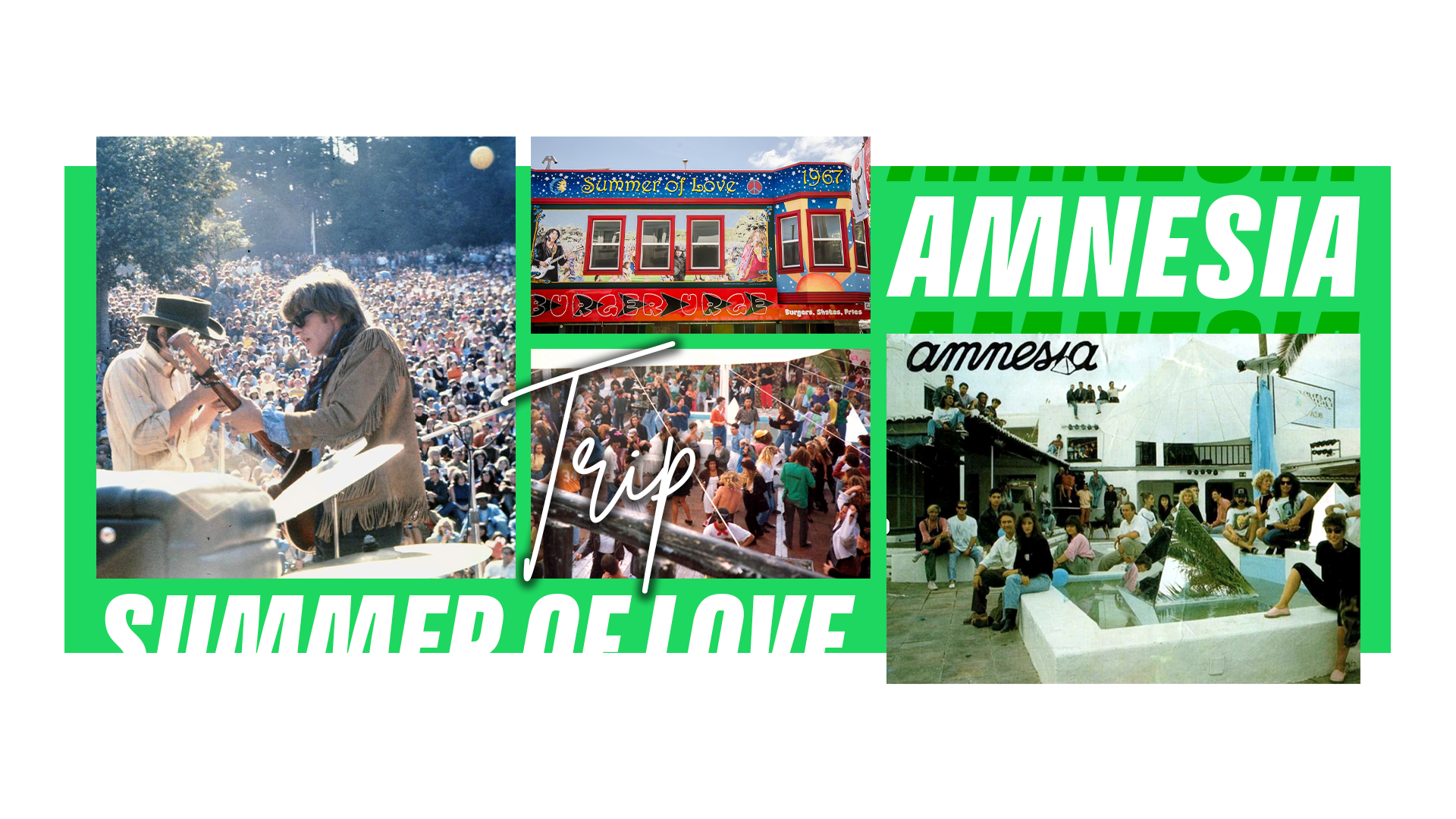
The Second Summer of Love does not only describe the musical explosion of 1988. Originally, the expression refers to an even older cultural heritage: the first Summer of Love in 1967. The term was reused in 1988 by British media and rave culture figures to establish a parallel between two historical moments connected by similar themes: youth, celebration, psychedelic drugs and above all the dawn of a new world alongside an intense search for a collective utopia built on the temporary rejection of dominant social norms.
The first Summer of Love took place during the summer of 1967 in San Francisco, particularly in the Haight-Ashbury district, which became the epicenter of the American hippie counterculture. Tens of thousands of young people gathered there around pacifist ideals and artistic experimentation with a desire to break away from the conservative and militarised America of the time. Psychedelic music, LSD, alternative communities and the slogan “peace and love” became the symbols of a generation searching for new ways of living together.
When the expression reappeared at the end of the 1980s, the context had obviously changed. After May ‘68, the world and social attitudes had already been deeply shaken by a growing desire for freedom and autonomy. Yet in 1988, many of the same dynamics strongly resonated again. This cultural transfer is precisely what gives the expression Second Summer of Love its meaning. Just like in 1967, it describes a moment of cultural transformation in which an entire generation experiments with another way of living. This time, however, music becomes even more fundamental, intrinsically connected to the defence of freedom itself.
But this was never only about music. Electronic music has often been described as a lifestyle for a reason: the freedom to dance however you want, to take whatever you want, to listen to whatever you want, to do whatever you want and to arrive exactly as you are.
The Trip That Changed Everything
The Second Summer of Love exploded and melted onto every tongue during the summer of 1988 in England, but its real starting point began one year earlier, thousands of kilometres away from London, on a Balearic island we know very well. Summer 1987. Paul Oakenfold, Danny Rampling, Nicky Holloway and Johnny Walker arrive on the island without imagining the revelation awaiting them, or that they were about to trigger one of the most important cultural mutations in the history of nightlife and music.
At the time, Ibiza was nothing like the island we know today, still far removed from the electronic and tourist industry it now represents. It had the reputation of being a marginal place, a paradise for strange hedonists and hippies, in short, a place filled with people who were not afraid of happiness. At the heart of the island stood Amnesia, and above all one of its residents: DJ Alfredo. For the London visitors, it was a revelation. Funk, pop, house, disco and electronic records blended together without any concern for genre boundaries. This was called Balearic Beats.
Among them was one of the often forgotten figures in the spread of the Second Summer of Love spirit: Nancy Noise. A London DJ who would later become a resident at Paul Oakenfold’s The Future nights in 1988, she belonged to that generation that discovered Ibiza and directly helped import the Balearic spirit back to the UK. In 1986 she discovered acid house and later described it in Mixmag:
“They played the same music all summer long. It was like Balearic brainwashing. When we got home, Amnesia was literally the only thing we could talk about. We were going crazy!”
Maybe it was during those years, when heat and ecstasy melted the dancefloor itself, that Ibiza became the island with the unbreakable soul it still carries today.
Completely overwhelmed by what she had experienced, Nancy decided to return the following summer to spend every night at Amnesia. There she met a friend of Paul Oakenfold and one year later, after seeing her vinyl collection in London, he invited her to become a resident at his nights. And just like that, the deal was done. It only took a tiny spark for the Balearic house virus to contaminate the UK capital, which, at the time, was desperately thirsty for one thing: a proper cultural shock.
British DJs did not simply bring back a few records in their luggage. They imported an entirely new way of living: more collective, more sensory and far less codified. Welcome to the Balearic spirit.
The Dancefloor vs Thatcherism
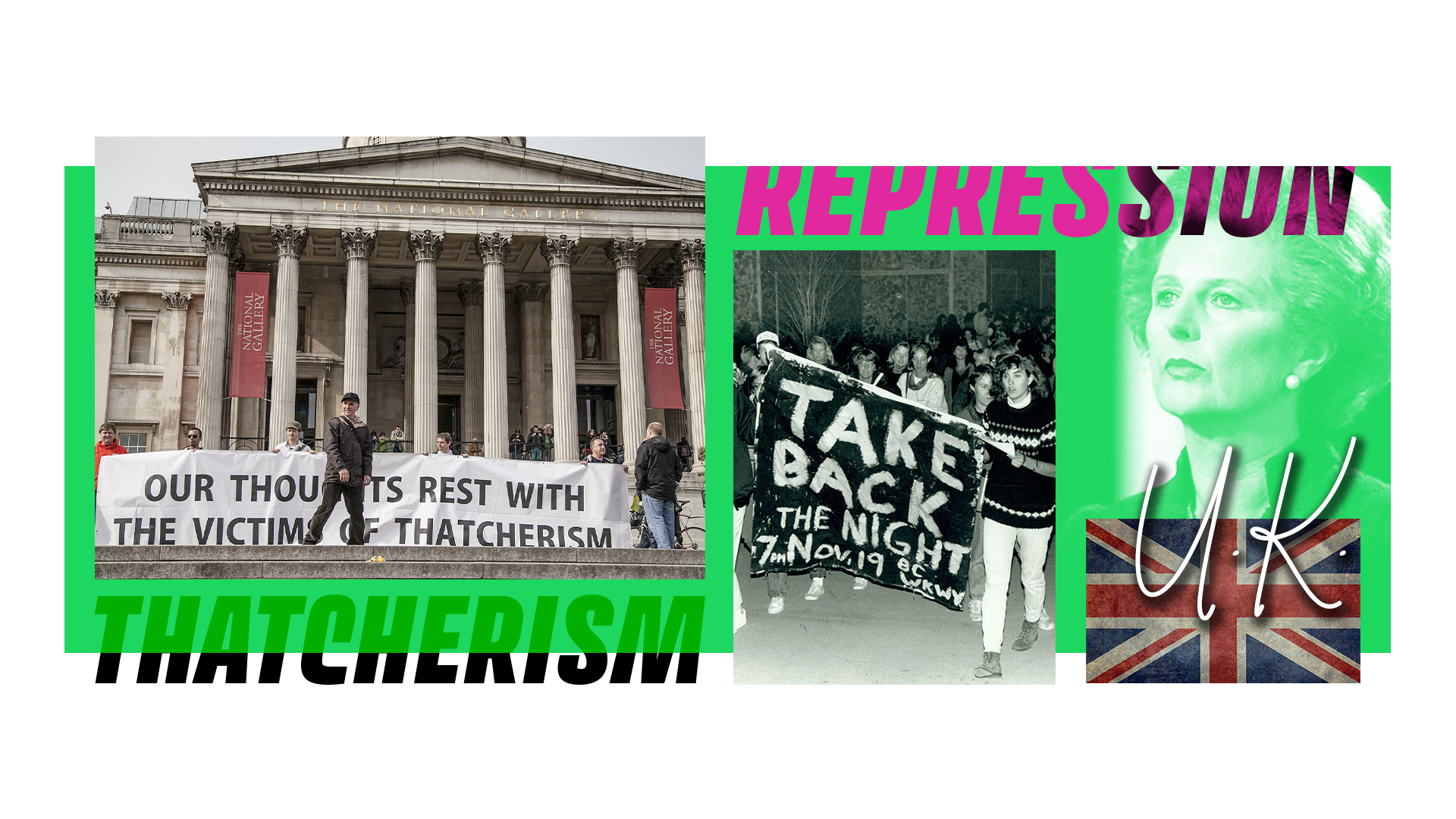
When acid house arrived in the United Kingdom at the end of the 1980s, the England in which the Second Summer of Love would spread had already been profoundly transformed by the Margaret Thatcher years. Since coming to power in 1979, the British Prime Minister had imposed an ultra-liberal economic policy built on privatisation, deregulation and above all individualism.
One of her most famous quotes perfectly summed up that vision: “There is no such thing as society. There are individual men and women and there are families.” When those words were spoken in 1987, they shocked large parts of the population because they seemed so disconnected from the social reality of Britain at the time.
The social consequences of Thatcherism were devastating. Factory closures and deindustrialisation hit former working-class regions hard. Local communities slowly fragmented while part of British youth grew up in a climate marked by unemployment, abandonment and intense social tension.
In major English cities, nightlife culture still revolved largely around pubs, alcohol and football terraces. People even referred to it as “pub culture.” A culture that strongly encouraged violence and hooliganism. Clashes between rival groups shaped weekends and increased insecurity to the point that Thatcher’s government intensified repression in an attempt to contain stadium violence.
In that climate, raves became symbols of hope, openness and also a fight for culture itself, a different culture from the one built around violence. A search for love, whatever form it could take, as long as it stood against hatred.
Yet what happened in London with Nancy Noise soon reproduced itself everywhere like an epidemic that would sweep across the whole of England. Small groups of DJs and an ever growing number of clubbers discovered house music: Andy Carroll and Mike Knowler in Liverpool, Graeme Park and DJ Jonathan in Nottingham; Nightmares On Wax in Leeds, Parrot and Winston in Sheffield, Slam and Harri in Scotland, while London had Colin Faver, Kid Batchelor, Jazzy M, Eddie Richards, the Watson brothers, Mark Moore and clubs such as Asylum, Shoom, Spectrum, Clink Street and The Dungeons.
“It was as if someone had suddenly plugged colour back in. Before that, nights out felt very dull, black and white, and now everything was bright colours. It’s hard to explain how exciting it all felt to us.” JD Twitch in Mixmag.
“We’re changing society, everything is going to change. And in some ways it did. People who had shitty jobs and hated their lives suddenly realised, ‘I don’t have to keep living like this.’ People who wanted to do something creative but didn’t know anyone else like them suddenly had a space where they could express themselves. In that sense, it changed a lot of lives.” JD Twitch in Mixmag.
In 1989, one year after the beginning of the acid house wave, clubs were no longer enough. Promoters started throwing parties wherever they could: abandoned warehouses, hangars, industrial wastelands and empty fields. The epidemic was no longer under control. Yellow smileys flooded flyers, secret phone lines multiplied and thousands of young people followed directions to locations whose exact whereabouts they sometimes did not discover until the very last moment.
Faced with this explosive growth, Thatcher’s government adopted increasingly severe measures against unlicensed gatherings. As repression intensified, tensions rose between British law enforcement and the most passionate defenders of free parties. On January 27, 1990, an event took place that would leave a lasting mark on the history of rave culture: the Freedom to Party Rally. More than 8,000 people flooded Trafalgar Square to protest against the Entertainments (Increased Penalties) Bill, also nicknamed the “Acid House Bill”.
Before this legislation, organising an unlicensed party could already result in penalties, but fines remained relatively modest. The government believed these sanctions did absolutely nothing to discourage rave promoters. The bill therefore dramatically increased the punishments:
• fines of up to £20,000
• up to six months in prison
• tougher penalties for organisers of unlicensed music events
Historically, the bill is often seen as the prelude to an even harsher wave of repression that would culminate a few years later with the Criminal Justice and Public Order Act of 1994, infamous for defining raves as gatherings characterised by a succession of “repetitive beats”. Yet, without realising it, this first attempt to control the movement also helped give it unprecedented visibility. With fluorescent smileys and festive slogans as its symbols, the movement gradually took on a political dimension. For many ravers, it was no longer simply about defending a style of music or a way of life, but about defending the very right to gather and celebrate.
“We have done all we can, all we ask of you is that you support the Freedom to Party campaign by coming to the rally at Trafalgar Square. Are you going to let them take away your right to party? NO!”
Wayne Antony, Tony Colston-Hater, Dave Roberts and Jarvis Sandy addressing the crowd, 909 Originals.
Smiley Nation
In this big bang of barely traceable circumstances, one thing remains: the symbols. The yellow smiley was never just a yellow smiley. It carried with it a concept, an idea, a light that acid and rave culture could project onto a generation thirsty to break free across Europe.
Fluorescent flyers circulated through clubs, record shops and from hand to hand. The information remained deliberately vague. Often, a phone number was the only thing printed on the flyer. Once dialled, an answering machine would provide an almost inaudible first meeting point before revealing the actual location a few hours later. Finding the venue was often an adventure in itself. Forget Google Maps. This generation was guided by sound alone.
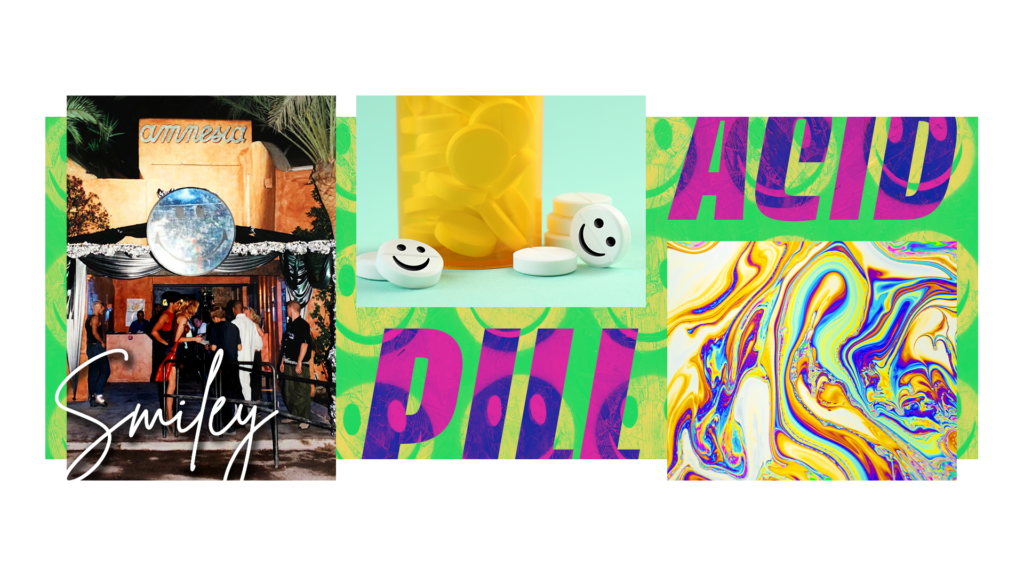
No symbol embodies this era more than the yellow smiley. Originally created in 1963 by American designer Harvey Ball to boost employee morale at an insurance company, it was adopted by the British acid house scene in the late 1980s. According to several accounts, its explosion within rave culture began after appearing on the flyers of Danny Rampling’s Shoom club. Soon, the logo spread everywhere: on clothes, badges, posters and city walls across Britain.
At first glance, it looked like a naive smile. In reality, the smiley became a clandestine sign of recognition, a symbol of collective euphoria and the unofficial flag of the Second Summer of Love and acid house itself. As Mixmag wrote, acid house culture eventually contaminated an entire generation to the point where
“all previous certainties melted away like a pill dissolving on the tongue.”
The smiley came to represent an old world temporarily dissolving before the emergence of another. A symbol that spread through bodies, dancefloors and minds across Europe, helping build a culture that, decades later, still fights many of the same battles and is driven by the same passion for freedom.
If a simple trip to Ibiza could spark an entire cultural and musical revolution before evolving into an international movement guided by the laws of acid and love alone, then perhaps the real question is this: When will we finally create the Third Summer of Love?
What we are witnessing today feels like the beginning of a new cycle. Across many societies, a renewed wave of social control, political polarization, and cultural repression is taking shape. These conditions resemble those that preceded previous cultural awakenings. In that sense, the present moment may be closer than we think to the conditions that once gave birth to the first and second Summer of Love and the acid house movement. Perhaps we are standing on the threshold of a new cultural renaissance, a Third Summer of Love waiting to emerge.
Sources :
https://mixmag.fr/feature/summeroflove-histoire
https://www.liberation.fr/musique/2017/02/10/aux-racines-de-l-acid_1547713
https://jack.canalplus.com/articles/lire/30-ans-apres-que-reste-t-il-du-second-summer-of-love
https://www.theguardian.com/music/2018/jul/01/thirty-years-since-the-second-summer-of-love-1988?
📷 : Cover Photo Credits : AI
📷 : Additional Photo Credits : Wikimédia Commons, Ben eine, Hoover Institution