In a music industry where recognition now depends as much on image as it does on production, Scan 7 continues to defend a different vision of success. As a longstanding Detroit collective, Scan 7 embodies an era when music was about bringing people together and passing something on, but also about transcending individual identities. Rooted in American underground culture, this philosophy raises a question that remains relevant today: do you really have to become “somebody” to leave a lasting mark on the history of electronic music?
How do we recognise a successful artist? By their name emblazoned across festival lineups? By the millions of streams they accumulate on digital platforms? By the recognition of their peers, or perhaps by their ability to make a living from their music? It is a question that runs through every artistic discipline, particularly in today’s world.
All it takes is a look at the evolution of major electronic music scenes to see just how much the status of the artist has changed. This evolution is not without its positive aspects. It also reflects the recognition earned by a culture that was long marginalised and had to fight for its place.
Some artists chose to build their identity around the idea of making the individual disappear to give music centre stage. Scan 7 is one such example. Hailing from Detroit, the collective developed a distinctive aesthetic that remains recognisable today: concealed faces and an enigmatic stage presence. Associated with two major institutions of techno, Underground Resistance and Tresor, Scan 7 belongs to a generation of artists for whom electronic music was a philosophy of life.
Among the collective’s key figures is Lou Robinson, better known as Trackmasta Lou. When he reflects on his career, we begin to understand what techno has gained, but also what it has gradually left behind as it has evolved into a global industry.
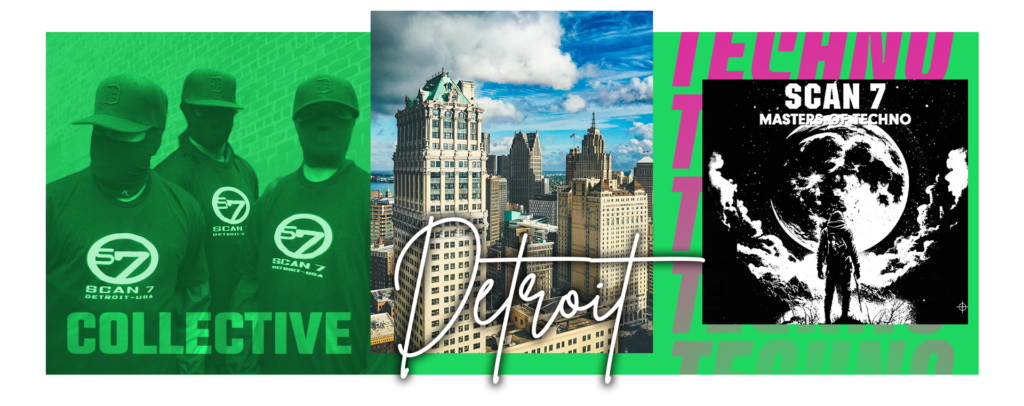
No Image, Just Sound in Detroit
When discussing his earliest influences, Trackmasta Lou first brings up The Electrifying Mojo.
“I was born and raised in Detroit City, and It begin in the late 80’s as I have always listened to music here in Detroit we was so spoiled and lucky to have a local (radio host) DJ by the name of The Electrifying Mojo that had a late night show back in the day that was allowed to play what whatever he wanted to play and that’s how I got introduced to Kraftwerk and many other European artists. The first gig I had was overseas, which surprise me to see a lot of people that listening and dancing to something that I created, and that’s when I said this is something I can definitely get use to doing.”
This influential Detroit radio personality played a decisive role in bringing together musical worlds that, at first glance, seemed far removed from one another. Through his late-night broadcasts, he introduced American audiences to European artists whose electronic sounds would go on to shape the imagination of future producers.
At the time, musical discovery relied on people capable of building bridges between different musical traditions. Radio DJs, record shop owners, collectors and enthusiasts all contributed to the circulation of music whose geographical boundaries were already becoming increasingly porous.
Detroit techno emerged from this very spirit. It did not develop in isolation, untouched by outside influences, but rather at the intersection of countless references and the musical explorations of the DJs of the time. European electronic experimentation met African American musical traditions and funk-derived rhythms, alongside a growing fascination with the possibilities and influence of electronic music.
In Lou Robinson’s account, this exchange stems from the endless curiosity that every artist should possess.
Scan 7: Disappearing Behind the Collective
Scan 7’s anonymity remains a symbol to this day. For Trackmasta Lou, being part of the group was above all an artistic commitment, but also a reflection of a particular understanding of collective creation. Asked how members were selected, he explains:
“Members was selected by there talent and the wellness to be apart of something bigger than themselves because at the end of the day it’s about the music and the ability to make the people dance.”
This approach to collective creation challenges the way we define artistic success today. Scan 7 has deliberately played with that boundary: a recognisable identity, with individual identities kept hidden. Being recognised for a musical universe rather than for one’s own persona.
Yet Scan 7’s approach also involves a form of artistic strategy. Masks and mystery constitute a powerful aesthetic within the underground scene because they carry a message and express a political stance. It is this commitment that has helped establish the collective’s reputation, almost as much as the music itself, which embodies that same message.

A Resistance That Goes Beyond Music?
Scan 7’s journey is inseparable from two major institutions in techno: Underground Resistance in Detroit and Tresor in Berlin. In their own ways, both labels have helped bring a form of music to an international audience whose identity has also been shaped by struggle.
For Trackmasta Lou, releasing music on these labels remains a particular source of pride. It represents a powerful mark of legitimacy, placing him among the artists whose contributions have earned them recognition within techno’s pioneering circles.
“Being on two of the historical labels on both sides of the pond.saying it was an honour would be an understatement.”
The relationship between Detroit and Berlin also tells part of techno’s story: that of a musical culture born out of encounters, cross-cultural influences, spaces of resistance, communities and experimentation, before becoming what it is today.
With Underground Resistance in particular, techno developed alongside a powerful political and cultural imagination. Founded in Detroit, the collective championed artistic and economic independence while embedding its music within an aesthetic of resistance to the dominant structures of the music industry.
What are we resisting when we make music?
The standardisation of productions? Dependence on major commercial structures? The constant pressure to put ourselves on display? Or the idea that artistic success should be measured by the fame of the person creating the work?
Trackmasta Lou’s journey invites us to question all of these assumptions. Above all, it reminds us that another relationship between music, image and recognition remains possible, or, at the very least, that it once seemed more attainable.
Can an artist still afford to do without all of this today?
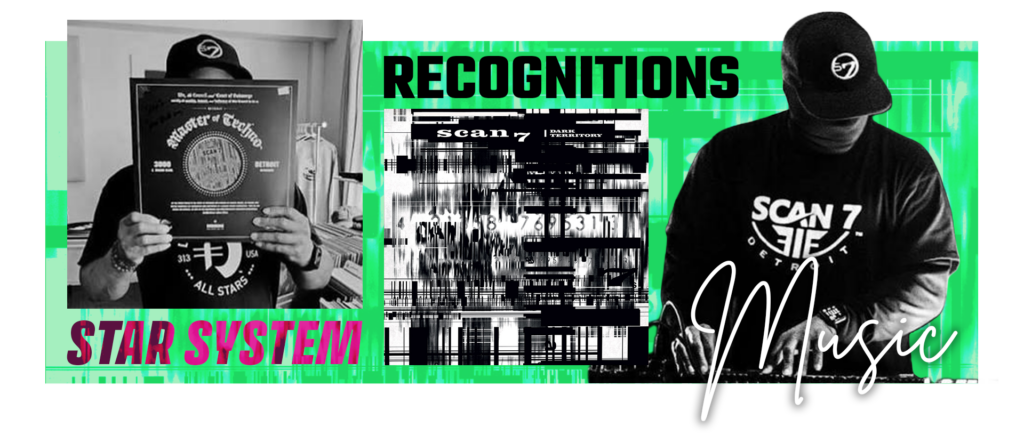
Behind the Masks, Human Stories
It would be tempting to remember Scan 7 solely for its mysterious aesthetic, its productions or its ties to Detroit’s underground scene. Yet when Trackmasta Lou talks about the most memorable moment of his career, he talks about his mother.
“When my mom witness me playing at the first (D.E.M.F.) Detroit Electronic Music Festival in 2000. I had to show my mom what all the noise she called it all about nothing in the world cantop me seeing my mom front and center.”
In 2000, Scan 7 performed at the inaugural edition of the Detroit Electronic Music Festival, a landmark event for the city’s electronic music scene. On that occasion, Carl Craig invited the collective to close the underground stage.
Yet success can also be measured through the recognition of those closest to us and that of our audience. It is another way of giving meaning to recognition, but also of finding a purpose for music itself.
When asked what he hopes to achieve through his work, Lou Robinson explains:
“Making music that brings people together from all walks to life (…)To reach as many people as possible with the message through music. And wish music could be free to those that can’t afford it.”
What If Success Simply Meant Leaving Something Behind?
Scan 7’s story does not prove that techno has lost its soul, nor that today’s artists have abandoned the principles that drove their predecessors. Such a conclusion would overlook the diversity of today’s electronic music scene, the collectives that continue to defend independent spaces, the labels that prioritise experimentation and the artists for whom music remains first and foremost a means of expression.
But it would be equally reductive to romanticise yesterday’s underground. Even movements that distance themselves from commercial logic develop identities, seek out audiences and participate, in their own way, in a cultural economy.
Trackmasta Lou’s testimony allows us to shift our perspective.
Success can be measured by what an artist passes on, by the people they bring together and by the influence they continue to exert without necessarily stepping into the spotlight. Without becoming a star. By concealing their faces, the members of Scan 7 have, paradoxically, left a lasting mark.
At a time when artistic careers sometimes seem to revolve around the constant need to be seen, their journey reminds us of a truth that the music industry increasingly obscures: we can make our mark through what we create (obviously).
Even if today’s music industry, and the world as we know it, are no longer designed to make that enough. The challenge, then, remains considerable.
At the end of the interview, when asked what techno means to him, Lou Robinson replies:
“An advancement with endless possibilities.”
Beyond the emotions it evokes, techno represents a cultural legacy. But it also embodies the future and progress. Above all, it represents an infinite range of possibilities, possibilities that should make techno itself the one and only star.
Photos Credits : SCAN7 IG
Interview : The Book of Techno by Mark Petes Varga