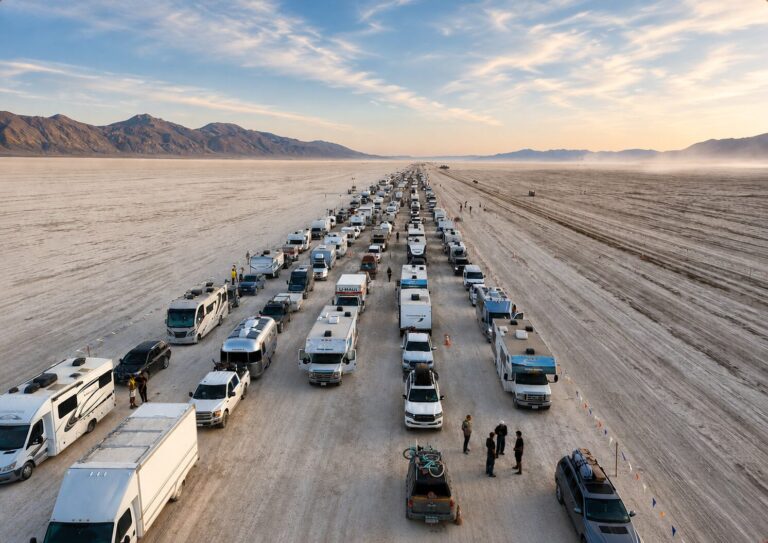
For one week each year, Nevada’s Black Rock Desert transforms into Black Rock City, a temporary world shaped by radical architecture, experimental engineering and artworks that often defy conventional ideas of what can be built.
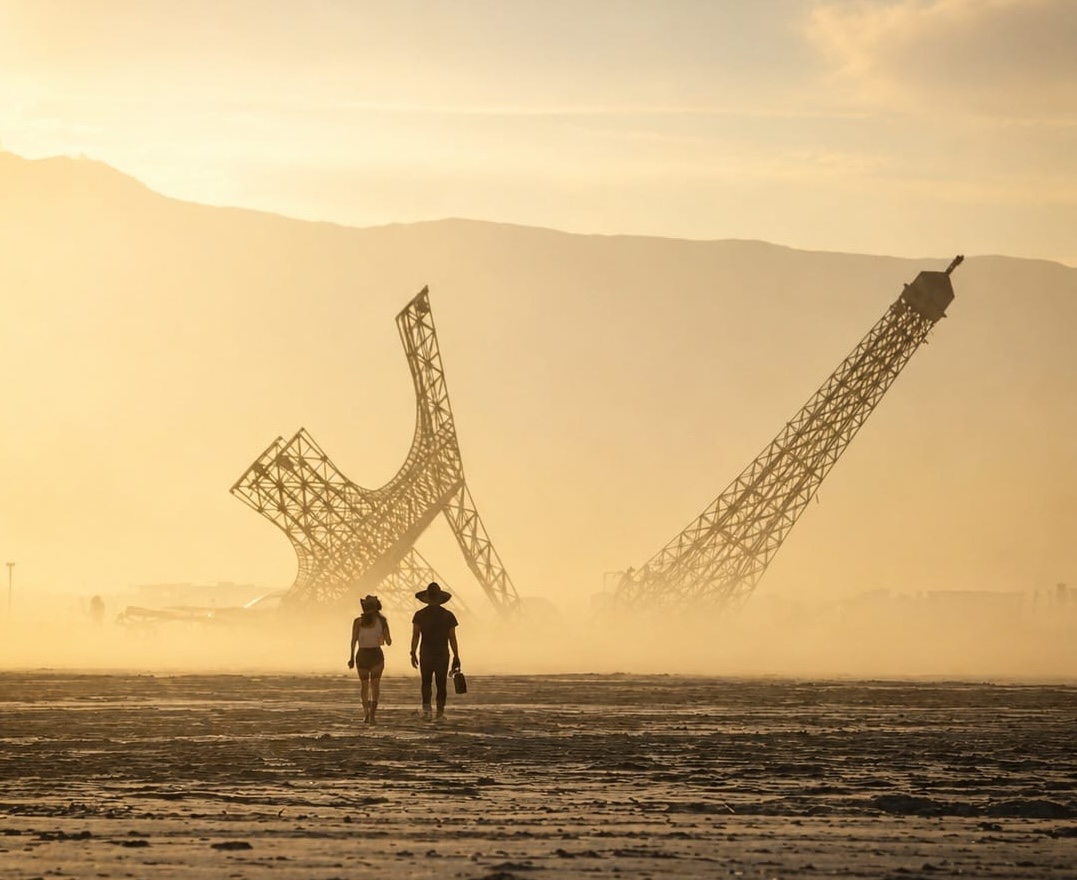
Burning Man 2026 has already kicked off with some of its most ambitious creations yet: from a colossal human head rooted in Persian mythology to a surreal Titanic seemingly sinking into the playa. But the installation everyone is talking about is Eiffela Broken Dream: a fractured, dust‑covered reinterpretation of the Eiffel Tower rising out of the sand, already spreading like wildfire across social media.
This year’s theme, Axis Mundi, explores connections between people, communities and the natural world. Across major Honoraria projects and hundreds of other installations, artists are interpreting that idea through monumental structures, interactive environments and mutant vehicles combining sculpture, sound, lighting, fire and ambitious engineering.
With more than 70,000 people expected in the Black Rock Desert, these creations are set to become some of the defining sights of Burning Man 2026.
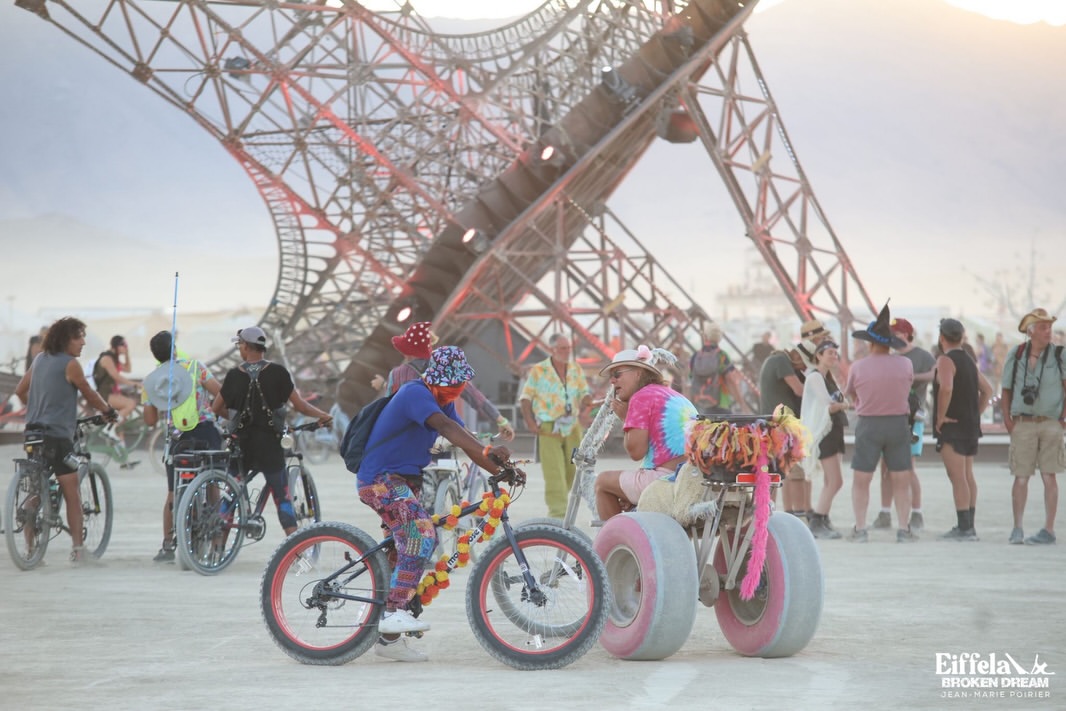
Photo Credits / Courtesy of Eiffela Broken Dream, Maindron Production and Jean Marie Poirier
Built to Roam the Desert
Mutant vehicles are among Burning Man’s most recognizable forms of moving art, transforming cars, trucks and custom-built platforms into enormous mobile sculptures that travel across the playa.
Several established icons are returning to Black Rock City in 2026. Among them is El Pulpo Magnifico, Duane Flatmo’s legendary fire-breathing mechanical octopus, whose articulated tentacles and bursts of flame have made it one of Burning Man’s most recognizable moving sculptures.
Also back on the playa is Monaco, Greg Barron’s enormous triple-masted land-sailing ship. Designed as a half-scale interpretation of a historic frigate, the vessel creates the surreal impression of a ship sailing across an ocean of dust.
¡AXOLOTL! The Earth Guardian, created by Camp Axolotl from San Miguel de Allende, Mexico, is also returning in 2026. Nearly 50 feet long, the monumental creature serves as a mobile space for music, performance and gatherings while carrying an environmental message inspired by Mexico’s endangered axolotl.
Known for its extraordinary regenerative abilities, the axolotl has become a symbol of ecological vulnerability and resilience as its natural habitat around Mexico City continues to face pressure.
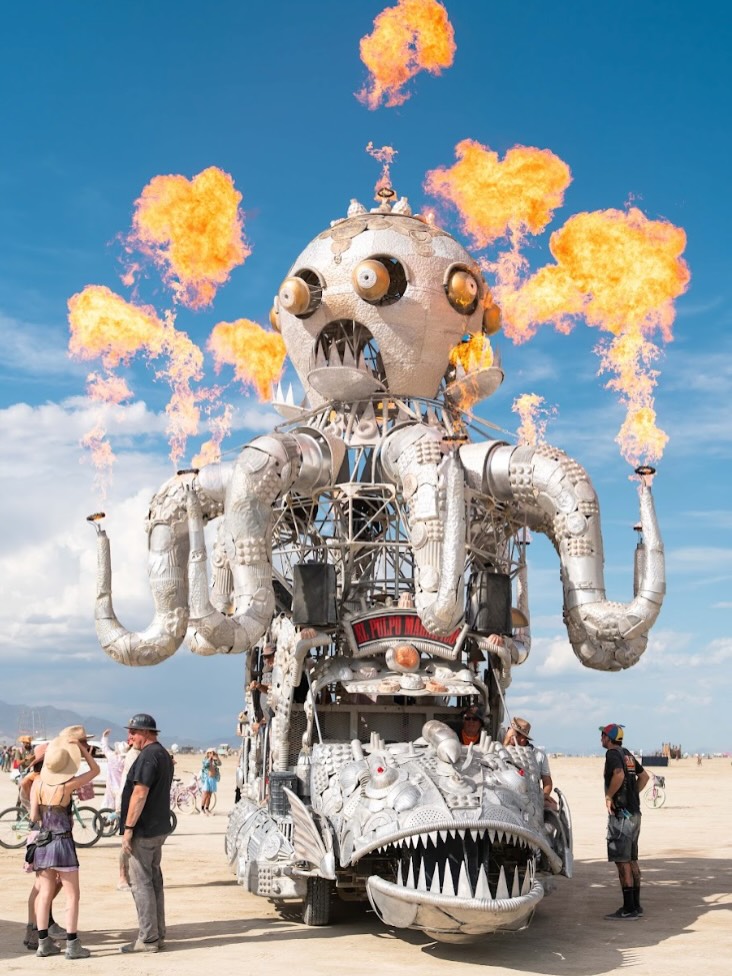
Photo Credits / Courtesy of El Pulpo Magnifico, Rising Sparks, Mia Terracotta Media
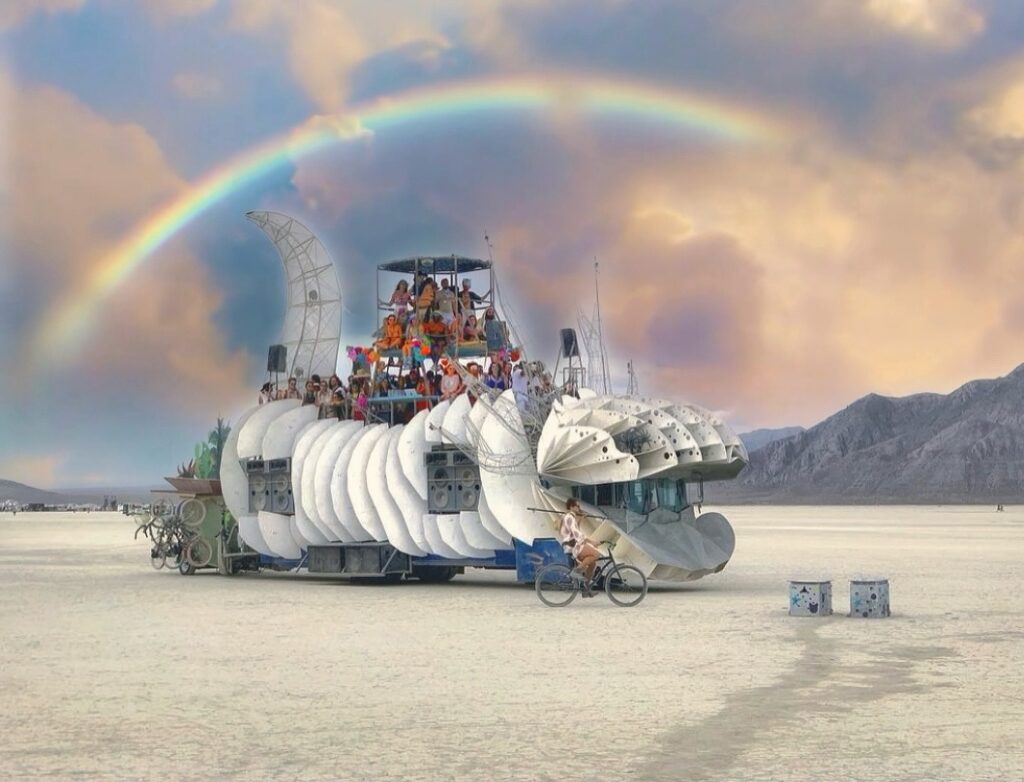
Photo Credits / Courtesy of Axolotl: The Art Car ( @axolotlearthguardian via Instagram)
Dragons, Snails and a Ukrainian Blue Bull
Some of Burning Man’s mutant vehicles carry stories that reach well beyond their spectacular appearance.
Abraxas, created collectively by LuvWorx, has been part of Burning Man since 2006. The dragon-shaped vehicle combines music and performance with a project that has grown into a wider community. Members of the team have participated in humanitarian and disaster relief work, including efforts following Hurricane Helene in North Carolina, while also supporting the Moonlight Orphanage in Uganda.
The vehicle’s creators describe Abraxas not as the work of a single owner, but as the product of almost two decades of collective creativity.
Blue Bull, meanwhile, transforms an artwork created nearly 80 years ago into a moving sculpture. Developed by Yaroslav Korets, Kurenivka, Wonders Workshop and collaborators across Kyiv, Odesa and the United States, the vehicle takes inspiration from Ukrainian artist Maria Prymachenko’s 1947 painting Blue Bull.
Covered in bright blue UV-reactive fur and enhanced with light and sound, the project carries Ukrainian artistic identity into the Nevada desert while reflecting themes of cultural memory and resilience.
A very different creature can be found in Golden Mean, created by Kyrsten Mate, Jon Sarriugarte and EOD. Inspired partly by the mathematical golden ratio, the Giant Pink Sea Snail from Doctor Dolittle, mechanical elephant puppets and the imaginative machinery of Jules Verne, the snail-shaped vehicle began with a dream and another humble napkin sketch before being constructed by a small team.
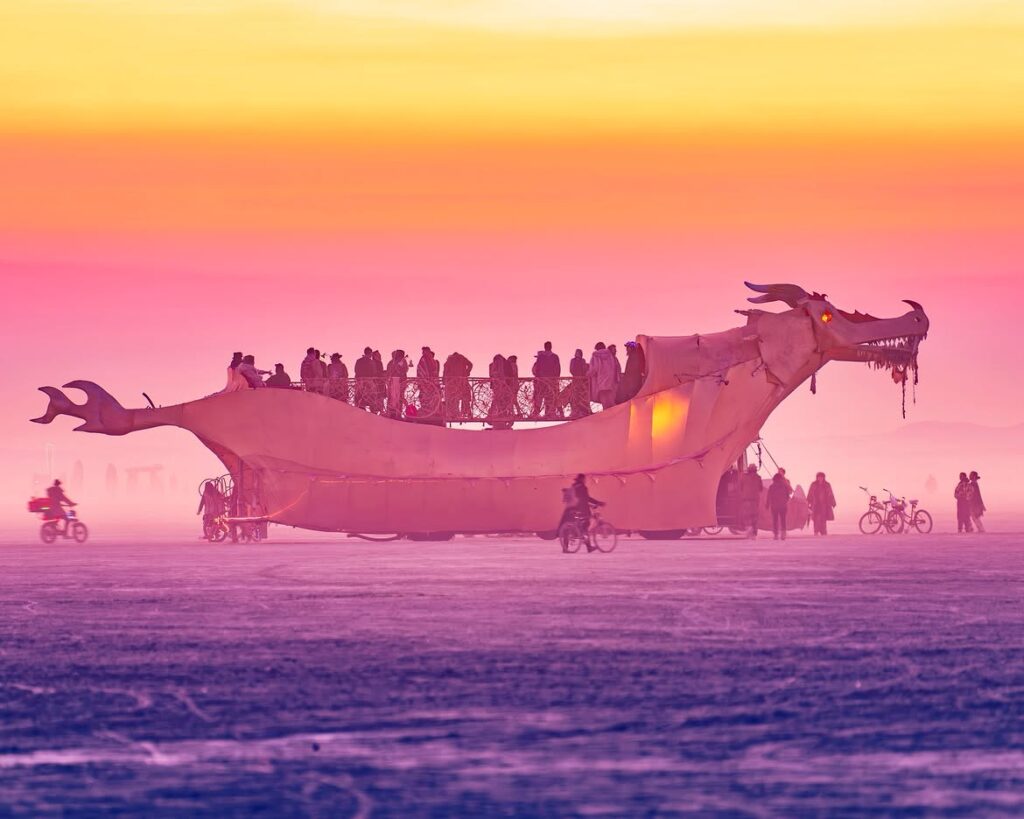
Photo Credits / Courtesy of Abraxas Dragon and Mark Fromson
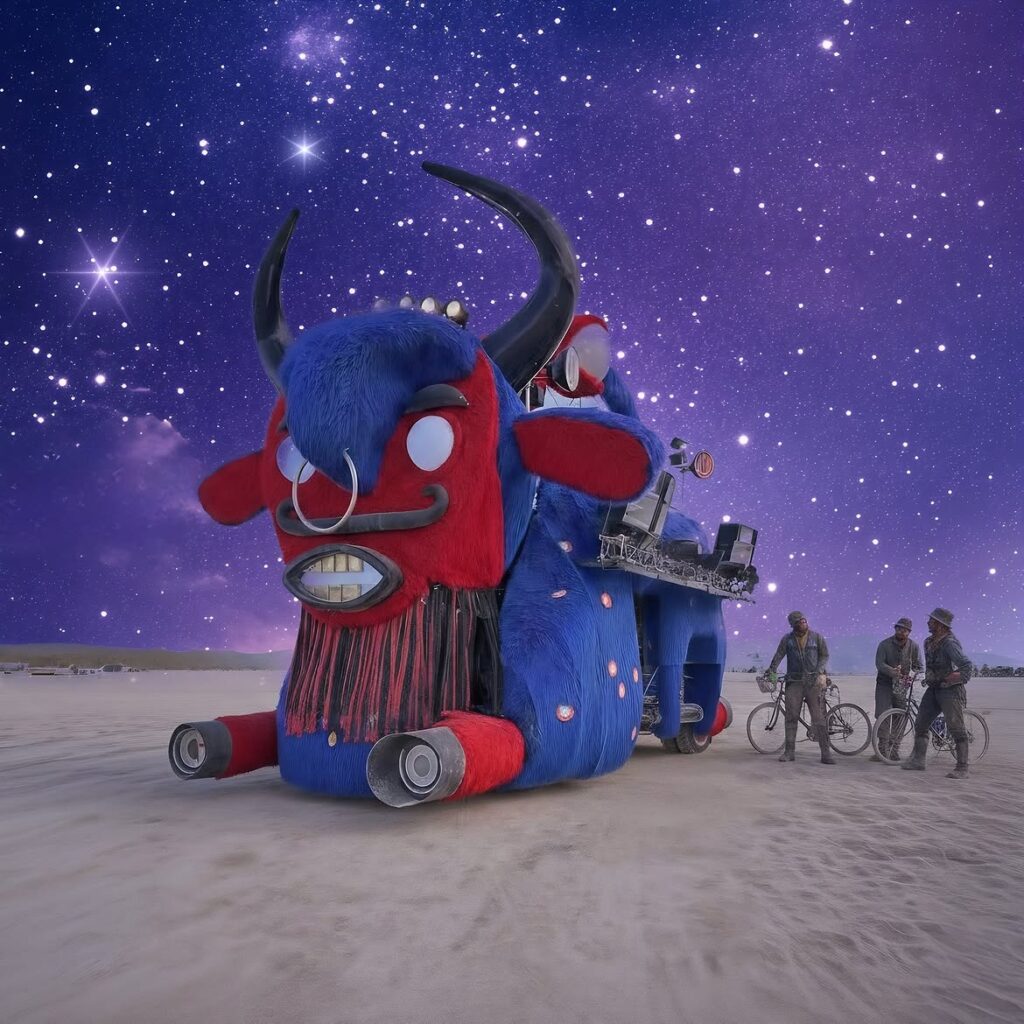
Photo Credits / Courtesy of Blue Bull Art Car, Yaro Korets, PabloLoKey, Kurenivka Art community
The New Mutant Vehicles of 2026
Burning Man’s mutant vehicle program mixes returning favorites with new builds, so simply appearing in the 2026 directory does not necessarily mean a vehicle was created this year. Among the projects most closely associated with the current edition are several striking new concepts.
Regal Eagle
Created by Garry Sutherland, Shawn Lusebrink and Rachael Buselmeier, Regal Eagle is a sculptural Art Deco bird formed using the traditional English wheel metalworking technique.
Burning Man’s official directory describes the vehicle as “a true gift to Black Rock City for 2026,” distinguishing it from the many older mutant vehicles returning to the playa this year.
Don’t Panic
Created by Sergey Nahodi and Dreamery Crew, Don’t Panic takes the form of a colossal supercomputer and spaceship inspired by The Hitchhiker’s Guide to the Galaxy.
Giant glowing screens form its robotic head, while a neon-lit city appears to power the machine beneath. Its concept playfully questions humanity’s increasing dependence on artificial intelligence while connecting directly with the 2026 Axis Mundi theme.
TRION
Mexico City’s FOMO team brings a more geometric vision to the desert with TRION, conceived as a moving temple of light and sound.
Built around the triangle as a symbol of balance, ascension and connection, the mutant vehicle combines sacred geometry with contemporary lighting, technology and electronic music. By night, its illuminated triangular structure becomes both a roaming sculpture and a mobile musical stage.
A Fairytale Tower Built for the Playa
Among this year’s major installations is Above & Below, led by artist Sean Orlando and fabricated by Engineered Artworks in collaboration with Five Ton Crane Arts Collective and dozens of contributing artists.
The 50-foot structure begins with a house at ground level before a twisting beanstalk rises toward a Victorian cottage above. Constructed from steel, wood, recycled materials and found objects, it is designed not simply to be observed but explored.
More than 130 artists, fabricators and volunteers have contributed to the project.
The installation imagines a post-apocalyptic world focused not on destruction, but on what happens afterward. Its fictional inhabitants rebuild using discarded objects, fragments of the past and their own creativity.
Engineering such a structure for Burning Man creates another layer of difficulty. Above & Below must withstand desert conditions and thousands of visitors while remaining modular enough to be transported on large flatbed trucks and reconstructed at Black Rock City within days.
The challenge is not merely making something enormous. It is making something enormous that still feels magical.
The Temple of the Moon
Burning Man’s temple occupies a very different emotional space.
For 2026, Temple of the Moon takes inspiration from the Queen of the Night, a desert cactus flower that blooms for a single night before fading after sunrise.
Created by lead artist James Gwertzman, architect Annie Locke Scherer, Moonlight Collective and the Temple Build Crew, the installation curves inward around a 30-foot central tower.
The space is intended for reflection, remembrance and gathering. Its architecture draws on lunar cycles and the temporary life of the cactus flower, ideas particularly resonant within an event where an entire city is constructed only to disappear days later.
More than 100 builders contributed their time and energy to the project. At the end of Burning Man, the temple itself will follow one of the gathering’s most significant traditions when it is released by fire on Sunday night.
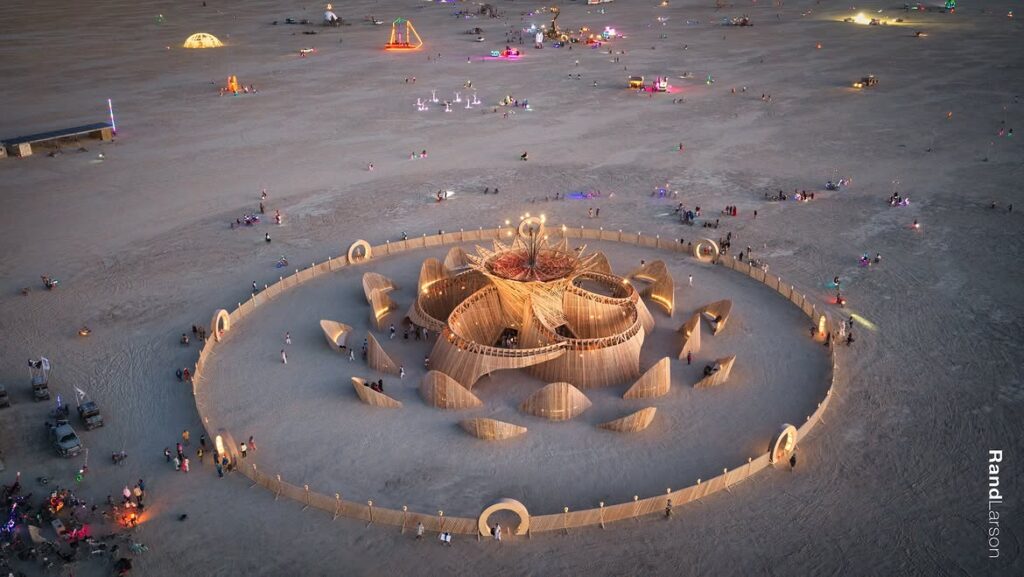
Photo Credits / Courtesy of Burning Man, Rand Larson, James Gwertzman, Temple of the Moon
At the Center of Black Rock City
The physical heart of this year’s Axis Mundi theme is Cryptomeria: The 2026 Man Pavilion, designed by Alexander Rose.
Inspired by Japan’s ancient Jōmon Sugi cedar tree, the three-level structure surrounds the Man and moves symbolically from roots and nature through the human realm toward the sky.
Root-like pathways guide visitors into the pavilion, while a double spiral staircase carries them upward. Its architecture directly interprets the year’s exploration of interconnected worlds, making Cryptomeria both a gathering point and the symbolic center of Black Rock City.
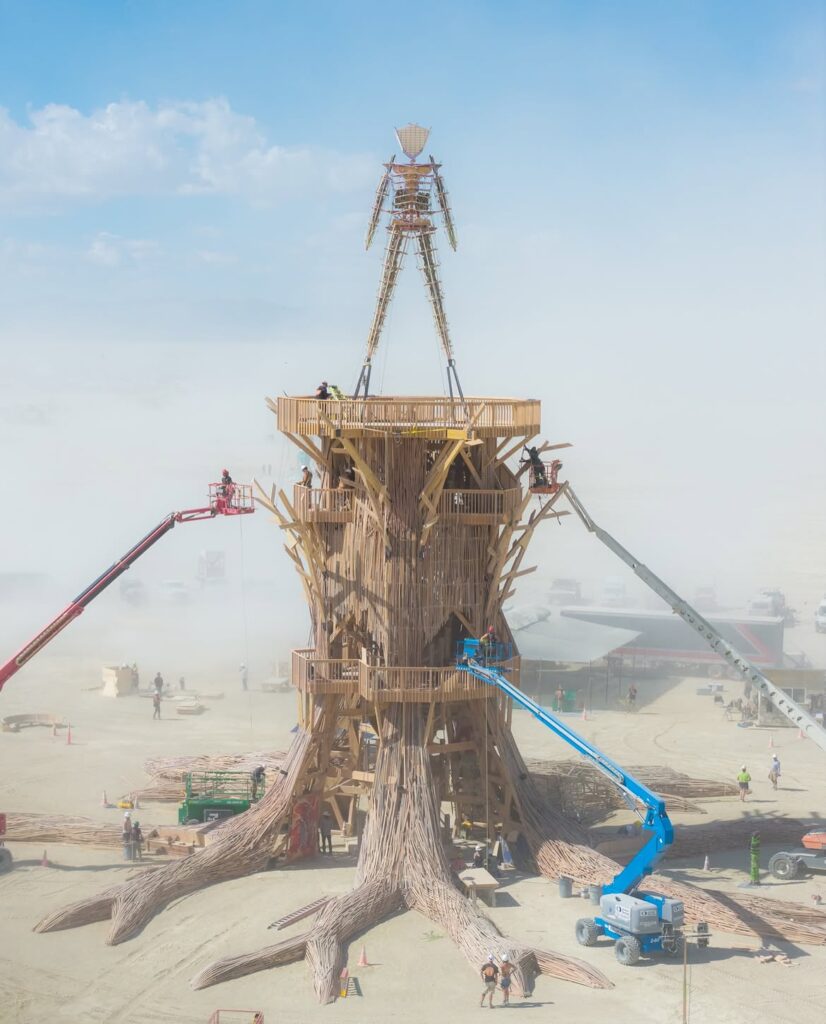
Photo Credits / Courtesy of Burning Man, Jamen Percy, Peter Platzgummer, El Pulpo Magnifico
The Titanic Sinks Into the Desert
Perhaps one of the strangest visual contradictions on the playa this year comes from TITANIC.
Created by San Francisco collective Titanic’s End and led by Chris DN, the installation depicts a huge wooden ship broken into two sections and apparently disappearing beneath the desert floor.
The wreck doubles as an informal amphitheater where Burners can gather for performances or watch the sunset. After dark, lighting transforms the structure, while flames emerging from its smokestacks add another surreal layer to the illusion.
Beyond the spectacle, the project raises questions around society’s confidence in technology, consumption of resources and the assumption that increasingly complicated human systems are too sophisticated to collapse.
Yet its immediate power is strikingly simple: an ocean liner sinking into a place where there is no ocean.
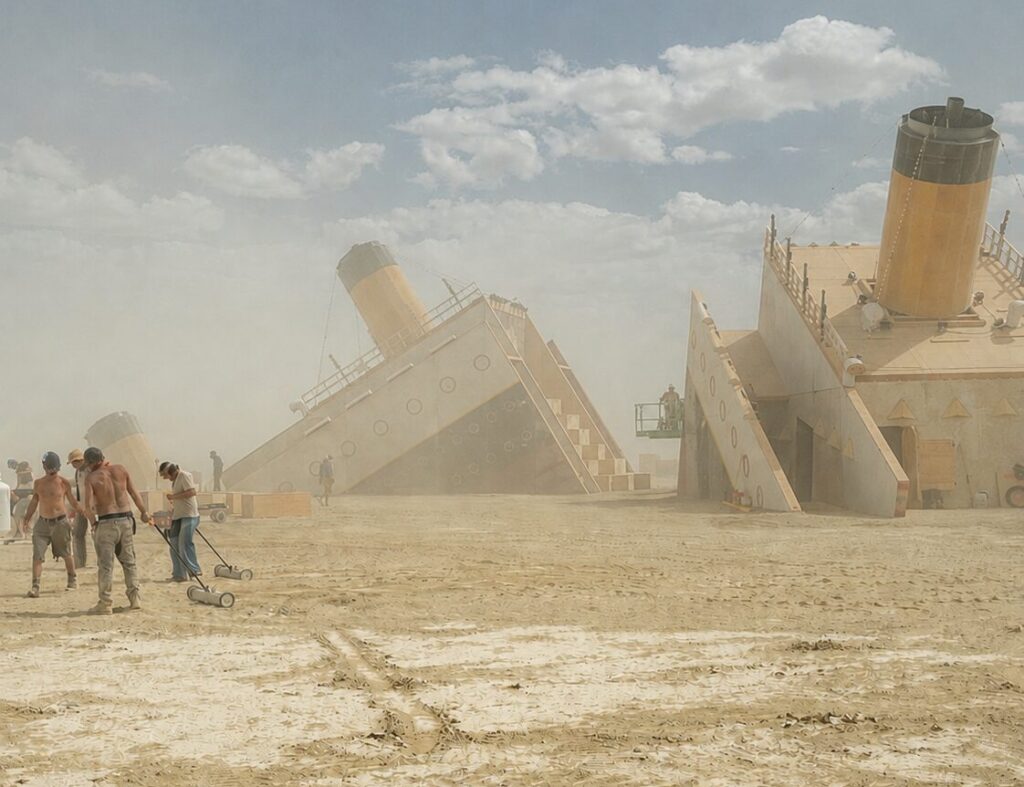
Photo Credits / Courtesy of Titanic’s End
From the Eiffel Tower to Ancient Persia
Eiffela Broken Dream, created by Philippe Maindron, similarly plays with the collision between familiar architecture and an impossible landscape.
The work recreates the Eiffel Tower at one-tenth of its original scale, but splits the monument into two sections as though it has crashed into the desert.
Its grounded lower half represents the collapse of a lost civilization, while the upper section points skyward as a symbol of hope. Connecting the two is a cable designed for a tightrope walker to cross, physically bridging destruction and possibility.
Nearby, ZARVAN brings Persian history, art and engineering into another monumental form.
Created by Gazelle Dasti, the 23-foot human head is inspired by the ancient Persian divinity associated with boundless time. Its exterior incorporates hand-painted Persian rug patterns and a luminous crown informed by traditional stained glass.
Inside, the sculpture becomes interactive. Periscopes positioned behind its eyes allow visitors to look across Black Rock City, while acoustic speaking tubes running through its ears enable people standing on opposite sides to communicate.
Dasti is the first Persian woman to receive a Burning Man Honorarium, adding another dimension to a work concerned with heritage, perception, time and human connection.
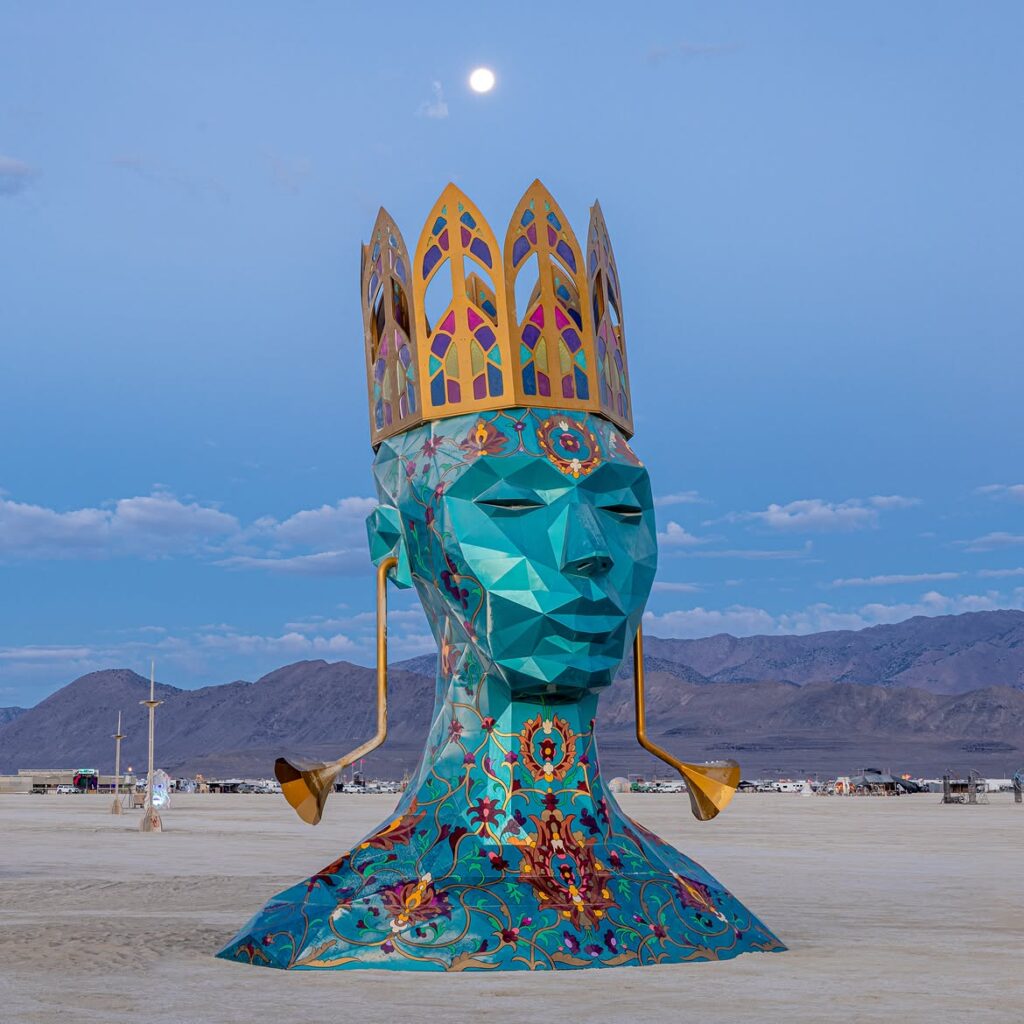
Photo Credits / Courtesy of Burning Man, Gazelle Dasti, ZARVAN
Building the Impossible
The visual spectacle of Burning Man can make these works appear spontaneous, almost as if they simply materialized from the dust. In reality, many are the result of months of fabrication, engineering, fundraising, transportation and collective labor.
Burning Man 2026 turns an eight-decade-old Ukrainian painting into a moving creature, builds a climbable 50-foot fairytale, fractures the Eiffel Tower across the desert and lets a 72-foot shark share the horizon with a sinking Titanic and a fire-breathing dragon.
Their impracticality is partly the point.
For one week, Black Rock City gives artists, engineers, builders and communities permission to create objects that would struggle to belong anywhere else. Then the temporary city disappears, leaving behind photographs, stories and the strange memory of seeing something impossible moving through the dust.
📷 : Cover Photo / Courtesy of Eiffela Broken Dream, Maindron Production and Philippe Maindron
📷 : Additional Photo Credits / Listed beneath each image