YouTube Music has begun introducing labels for tracks created primarily with generative AI, adding another major streaming platform to the growing movement toward greater transparency around artificial intelligence in music.
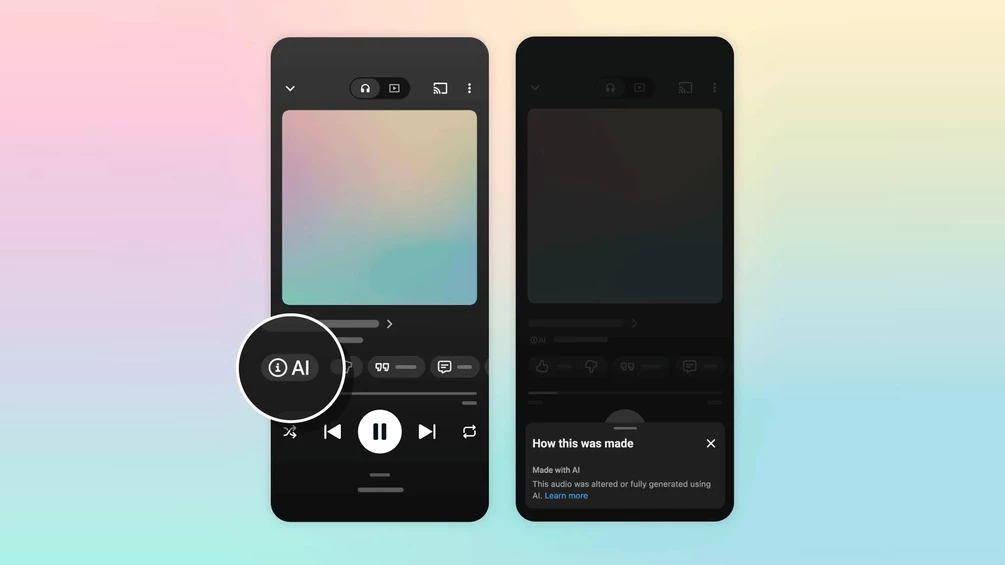
The new labels will appear directly on the YouTube Music player page and are intended to help listeners understand when generative AI has played a significant role in creating the music they are hearing.
Listeners will also be able to select the label to access additional information about how AI was involved.
According to YouTube, the system is designed to provide greater clarity as generative technology becomes increasingly integrated into music creation and distribution.
The labels focus on substantial uses of generative AI, including areas such as composition and vocals.

AI Transparency Moves Into the Player
The location of the new information is particularly significant.
Rather than placing AI disclosures somewhere deep inside track metadata, YouTube Music is bringing the information directly into the listening experience.
That gives audiences a more immediate indication of whether a track was created primarily through generative technology.
YouTube has explained that its objective is to make relevant information as accessible as possible for listeners seeking clarity about the music they consume.
The labeling system is also expected to expand beyond YouTube Music and appear on the main YouTube platform, although a specific timetable for that wider rollout has not yet been confirmed.
Streaming Platforms Are Defining Their AI Policies
YouTube Music is not operating in isolation.
Across 2026, streaming platforms, digital music services and distributors have increasingly begun establishing systems to distinguish between human created, AI assisted and substantially AI generated music.
Spotify announced plans to introduce an AI persona label for profiles identified as being generated through artificial intelligence, while Apple Music has been developing its own AI transparency tags.
Traxsource has taken a more explicit approach by introducing “Human Made” and “AI Assisted” classifications, creating a visible distinction between music created conventionally and releases where artificial intelligence has contributed to the production process.
TIDAL has gone further by addressing the economic side of the debate, announcing a policy excluding AI generated music from royalty payments.
Together, these approaches demonstrate that the industry is moving beyond the initial question of whether AI music belongs on streaming services. The more immediate challenge is becoming how platforms identify it, explain it to audiences and determine how it participates in existing royalty systems.

The Difference Between AI Generated and AI Assisted Music
That distinction could become increasingly important.
Artificial intelligence can enter the creative process at many different stages. An artist might use an AI powered tool for a specific production task while retaining creative control over composition, performance and arrangement.
At the other end of the spectrum, generative systems can produce vocals, compositions and complete recordings with far less direct human involvement.
Treating every use of artificial intelligence as identical would therefore risk obscuring major differences in how music is actually created.
YouTube Music’s focus on tracks made primarily through generative AI suggests an attempt to identify substantial AI involvement rather than simply flagging every production that has interacted with an AI powered tool.
As these technologies become more common inside music software, establishing that boundary is likely to become increasingly complicated.
AI Music Is Arriving at Enormous Scale
The urgency surrounding transparency is partly explained by the volume of AI related music now entering digital distribution.
A study shared by SubmitHub in August suggested that almost 40 percent of music released during July was flagged as containing AI generated or AI assisted material.
Earlier in the year, Deezer reported that AI generated music represented 44 percent of daily uploads to its platform.
Those figures illustrate the scale of the challenge confronting streaming services. Generative music is no longer a marginal experiment existing at the edges of digital distribution. It is entering platforms in quantities large enough to influence discovery systems, catalogues and potentially royalty allocation.
The issue also extends beyond how AI generated tracks are distributed.
Generative AI company Suno recently acknowledged that audio data scraped from YouTube had been used in training its models, highlighting another unresolved question surrounding where AI music systems obtain the material used to develop their capabilities.
Transparency Could Become the New Standard
The arrival of visible AI labels does not settle the wider debate surrounding artificial intelligence and music.
Questions involving copyright, training data, artist consent, identity, royalty distribution and the value of human creativity remain unresolved.
What the labels can provide is information.
For listeners, that means having greater visibility into the origins of a recording. For artists, it could create clearer distinctions between different forms of technological assistance. For platforms, it represents an attempt to establish rules before generative content becomes even more deeply embedded in music distribution.
There is also an important difference between labeling and judgment. Identifying that generative AI played a substantial role in creating a track does not necessarily determine its artistic value. Instead, it gives listeners additional context and allows them to decide how that information influences their relationship with the music.
With YouTube Music joining other major services in making AI involvement increasingly visible, 2026 is beginning to look like the year when artificial intelligence stopped being hidden somewhere inside the production process and started becoming part of the information attached to the music itself.
The next challenge will be ensuring that those labels remain meaningful as the line between human production and machine assistance becomes increasingly difficult to draw.
📸 : Cover Photo Credits / YouTube Music
📸 : Additional Photo Credits / Sanket Mishra (CCO License), Castorly Stock (CCO License), greenwish _(CCO License)