Call me late to the party, but before I’ve received the opportunity of writing this story I was fully unaware of the existence of Algorave. Yet, nothing has succeeded to inspire me on a deeper level lately than Algorave has done. Not only is this music phenomenon a global movement leading the future, more importantly it brings a sense of community to the dancefloor electronic music has lost over time.
In a dim, pulsating space somewhere between club and art installation a performer stands before a crowd armed not with decks, drum machines, or a curated USB stick, but with a laptop. Lines of code flash across a big screen, projected large enough for the room to see. Each keystroke reshapes the sound system in real time through which beats mutate, rhythms fracture, melodies surface and disappear.
In this niche subculture, music isn’t triggered or mixed, but written live. It is not quite DJing, not quite live electronics, and not quite performance art. Algorave sits at the intersection of human creativity and computational systems that borrows freely from all three.
Algorave: Theory on the Dancefloor
Algorave (short for algorithmic rave) is a live performance practice in which artists generate music by writing and manipulating code in real time. Rather than sequencing tracks in advance or triggering samples, performers construct systems that behave musically, responding to both intention and chance.
The movement emerged in the early 2010s from live coding communities that treated music as streams of data rather than fixed timelines. It spread through blogs, workshops, basement shows, and curious clicks rather than visibility in clubs. In 2013, a VICE article introduced the idea of Algorave to a broader audience, framing it as a strange collision of hacker culture and dance music. That article became a catalyst for many- including Mike aka Kindohm, one of the earliest musicians to build a performance practice around Algorave. What hooked him wasn’t technical novelty, but creative velocity. More than a decade later, the surprise remains central to his practice.
“I was immediately captivated and never looked back”, Mike told us. “It’s a great feeling to sit down, type a very small amount of code, and hear something I’ve never heard before.”
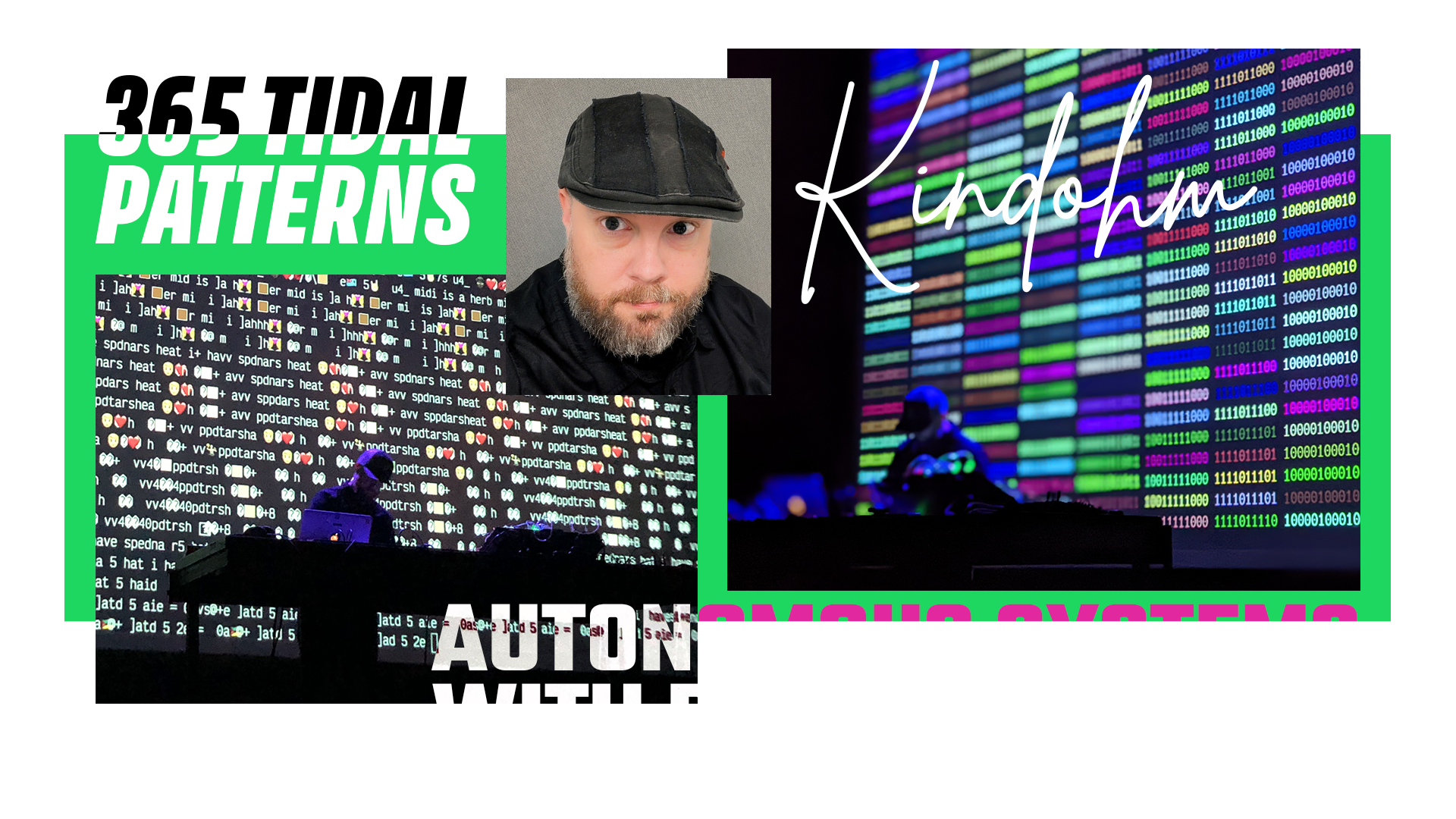
“When I learned about Algorave, there were a few people doing it in places like the UK, Germany, and Mexico. Now it has large communities and clubs all over the world.”
Central to this ecosystem is Tidal Cycles, a live coding language designed specifically for rhythmic and pattern-based music. Created by Alex McLean, Tidal Cycles reframes sequencing as an expressive, mathematical practice. Instead of placing notes on a grid, artists describe ‘rules’ for how patterns unfold over time.
Mike explains: “Tidal Cycles makes me think of sequencing like a stream of data. That stream can be slowed down, sped up, chopped and rearranged, reversed. Any algorithmic operation that could be applied to a list of data can be applied to sequencing.” A real unique feature of Tidal Cycles is pattern interference. This way of thinking adds something crucial: presence. The system is not left to run alone. It is steered, broken, and reshaped live, in front of an audience.
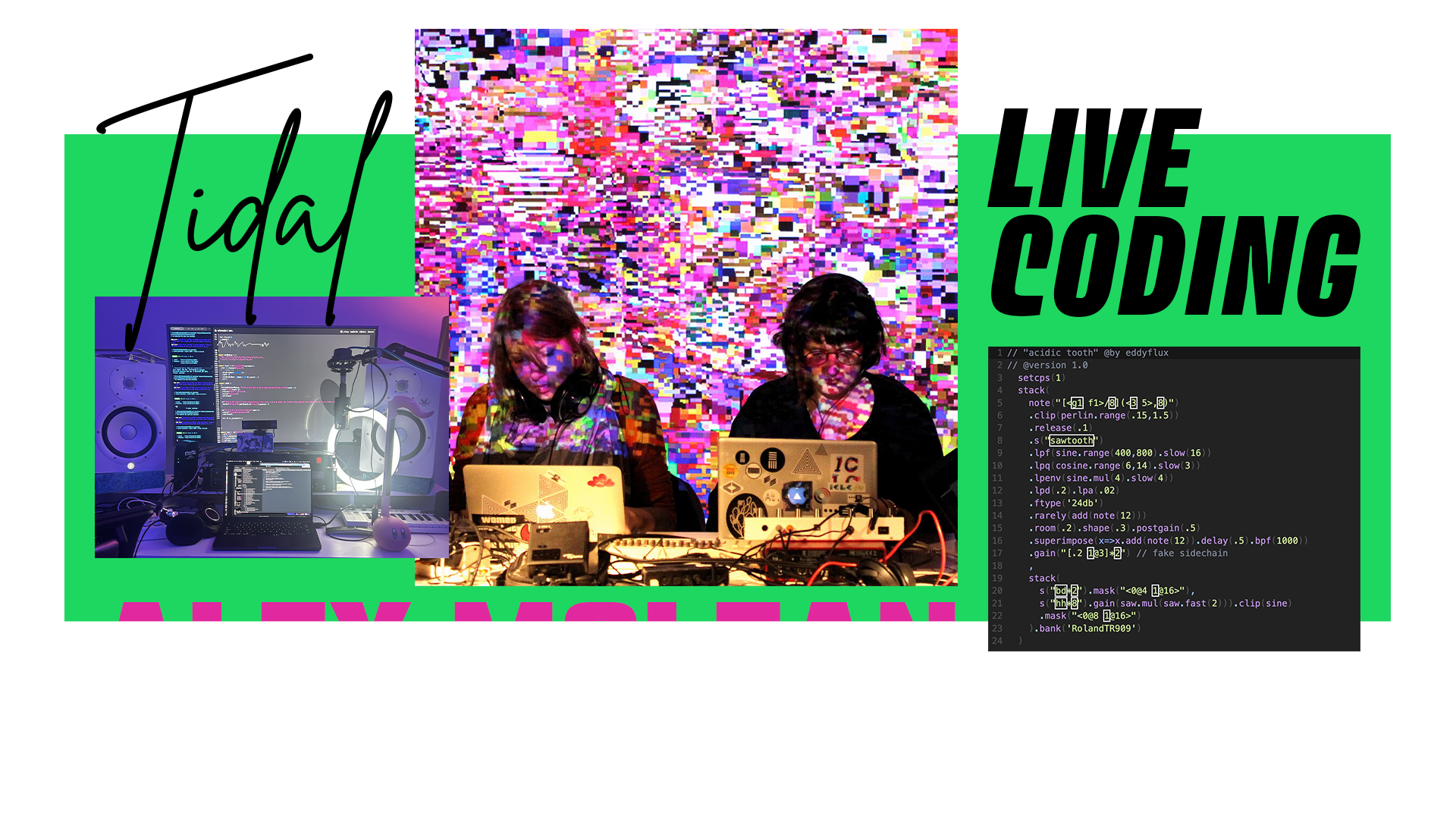
Mike continues: “Imagine two different streams of information: maybe one is when notes are triggered, and another is a parameter such as pitch or velocity. Those streams can be independently manipulated, but then layered on top of each other for unexpected outcomes. It’s kind of like today’s concept of “parameter locking”, except with the locks moving around.”
Transparency fuels community
Jade Rose, known on stage as Switch Angel, arrived at Algorave through a long and winding musical journey. She began making music as a child on a tracker running on a hacked PSP, later moving through FL Studio, modular synthesis, and even a detour into acoustic instrument building as a trained luthier.
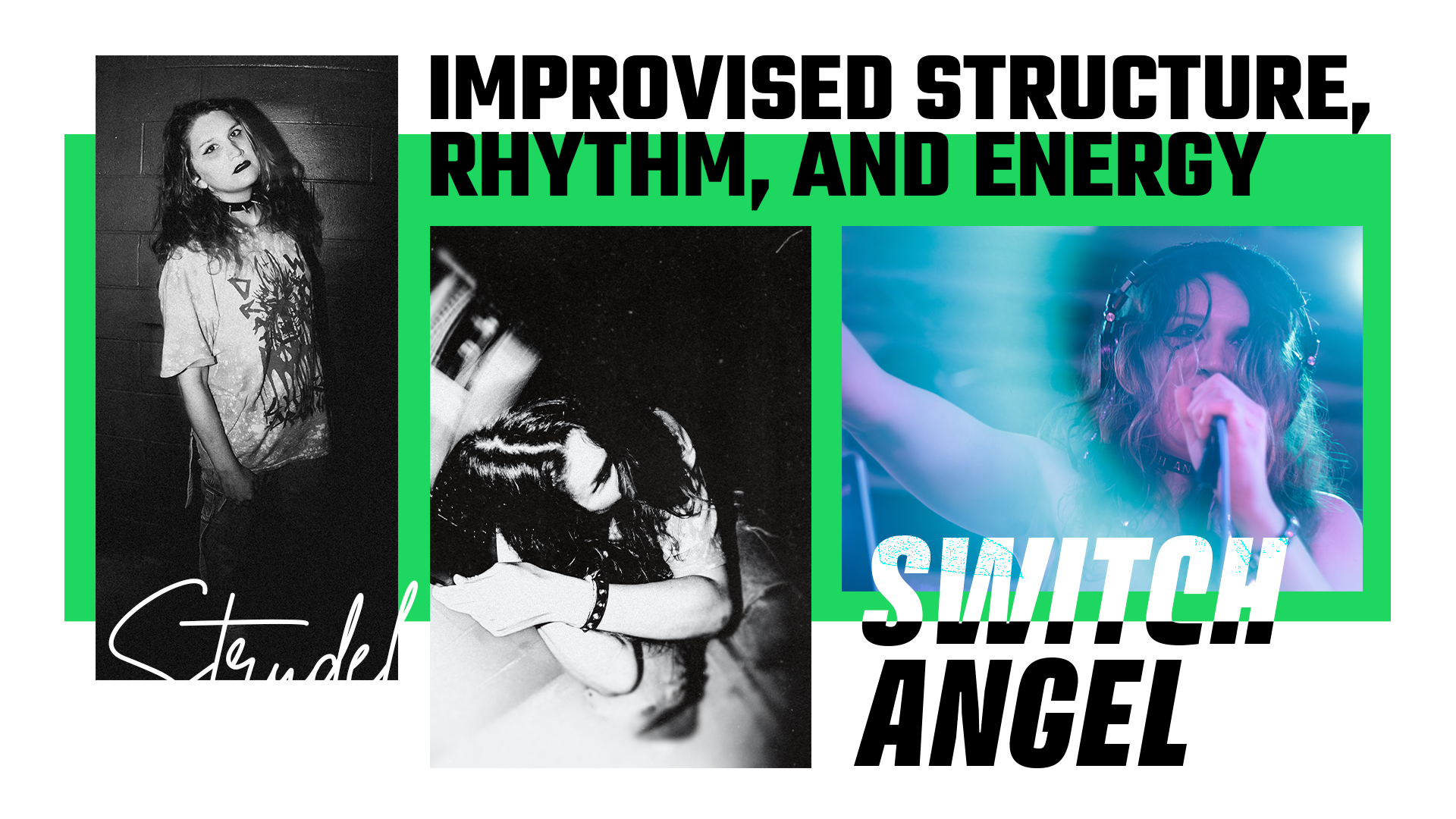
Her first encounter with live coding came through the Boston scene and it changed everything.
“I fell in love with the medium and its possibilities,” she says. “What resonated immediately was the freedom: the ability to improvise structure, rhythm, and energy without being locked into predefined forms.”
Today, Jade performs high-energy club sets and uploads videos on YouTube where she codes, sings, narrates, and reshapes systems in real time. She works primarily with Strudel, a community-driven project based on the Tidal Cycles framework, which she now helps maintain and shape. “My dreams are pretty much coming true,” she says. Jade’s performances blur the boundary between musician, programmer, and frontperson. She collaborates closely with visual artist LO.FI.SCI.FI, rejecting the traditional separation between performer and VJ.
“In Algorave, it is the norm to have the VJ on stage with the audience,” she explains. “It enhances both performances and reflects the culture behind Algorave.”
Here it is as much about what you see as what you hear. Code scrolls across screens, visual systems respond to musical changes, and performers move, sing, jump, and react.
Mike explains: “The audience should have a window into your process. However, the audience does not have to fully understand what they are looking at in order to appreciate the transparency.” The result is not spectacle for spectacle’s sake, but intimacy.
“The connection to the audience is my sole focus while performing,” Jade says. “Changing things aggressively in real time is the most effective way I’ve found to interact with people, like you would with traditional instruments.”
Mike approaches performance differently, often composing privately, leaning heavily into automated generation. But even there, the human presence remains essential. Live coding exposes thought itself, turning decision-making into something audible.
While talking to inspiring voices from the scene, what strikes me is how Algorave is a collective practice. It makes sense as from the beginning, its survival is dependent on tools that are free to use, communities that encourage participation, and a culture that values sharing over gatekeeping. Mike notes that Algorave “has always been about acceptance and participation, no matter what your experience is.” That generosity extends to ideas. Techniques, pattern logic, and entire performance approaches circulate freely.
“I’ve always liked giving away my ideas and sharing,” Mike says. “It honestly blows my mind to see people adapt to them.”
For Jade, this openness was immediately tangible. Her first Algorave show revealed a scene that was very open, diverse, and inclusive on all axes. In Algorave spaces, performers often stand among the audience. Code is projected not to intimidate, but to invite curiosity. Mistakes are not hidden, they are part of the music. Jade continues: “It takes many artists succeeding to make a scene strong.”
Algorave as a Future Interface
As AI-generated music becomes increasingly autonomous, Algorave offers a counter-model—one where systems remain touchable. Mike draws a clear distinction: “Autonomous systems can have randomness built in, but are they listening back and reacting to what they just did? Probably not.” Live coding, by contrast, demands attention, reaction, and improvisation. When something breaks, the performer must respond live, with the audience. These imperfections are fuel to the performance. Jade explains: “When I encounter limitations, that’s exciting,” she says. They point toward new tools, new interfaces, new ways of thinking.
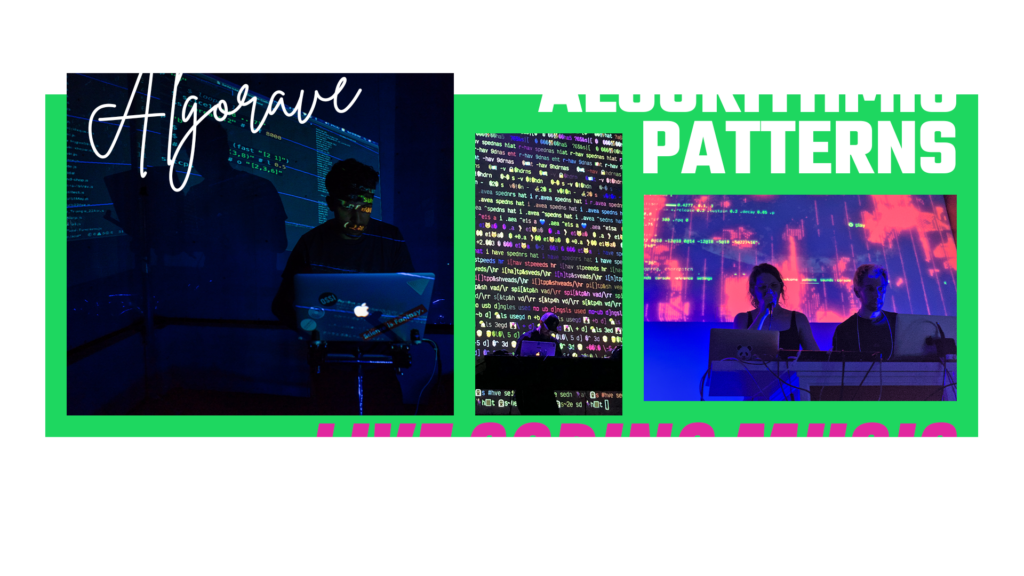
Algorave, in this sense, is not a rejection of electronic music history, it is a continuation of it. Like early house, techno, or rave culture, it emerged before its rules were written. Prejudices where Algorave acts as a junction at which hacker philosophy, geek culture and clubbing all meet, has now transformed into a practice that reminds us that technology does not have to be opaque to be powerful. It can be playful, expressive, and deeply human.
Here, the dance floor becomes a site of inquiry. The machine listens back. And the future of performance is typed, one line at a time.
Learn more on Algorave, Switch Angel, Kindohm, Strudel and Tidal Cycles
📷 : Cover Photo Credits / Courtesy of Switch Angel
📷 : Additional Photo Credits / Courtesy of Switch Angel, Mike Kindohm, Envato Elements, Algorave, Antonio Roberts CC License
📝 : We tried to reach to Tidal Cycles creator Alex McLean without luck, third illustration shows an Algorave event in Birmingham in 2016 with Antonio Roberts.
💚: Special thanks to Jade & Mike.