

In the beginning, in the electronic Garden of Eden, there was that particular silence which precedes all revolutions, the silence of an ear tilting on its axis, of a trajectory discovering its direction. Before the million-strong crowds massed along the Seine, before lasers carving through the nights of Houston and Moscow, before the synthesizer became a musical sign in itself, Jean-Michel Jarre was a young boy with one eye trained on the future without even wanting it. Convinced he had heard something on the lips of a machine that others dismissed as nothing more than cold beauty. Fifty years have passed. The vision hasn’t moved. As he prepares to perform for the first time in Ibiza for the fiftieth anniversary of Amnesia, temple of all trances, Jarre is that rare, unbending figure. He is a man who has devoted his entire life to pursuing emotion and experimentation where others saw only mechanics. From his inventor grandfather to the GRM, from Oxygène to artificial intelligence. His story follows the curve of those who love the machine, a love that never ceased to bloom in the hands of a man who embraced it at every stage of his life.
In the beginning, there was Jean-Michel Jarre. And the machine.
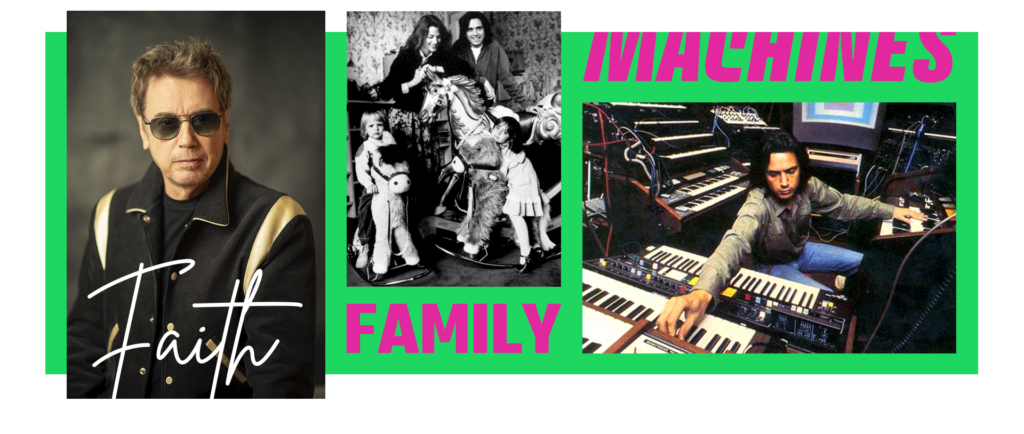
Echoes
Like the red thread that predestines lovers, Jean-Michel Jarre did not yet know the great love of his life, but he could already glimpse her everywhere around him, hear her, even brush her with his fingertips. She was there, she whom he would come to love so deeply, orbiting him always, like an object of endless curiosity.
André Jarre, his grandfather, engineer, inventor, oboe player and fisherman in his spare hours, contributed to the invention of the first mixing desk designed for French radio, and built the Teppaz, that small portable record player an entire generation held in their hands: the ancestor, Jean-Michel would later say, of the iPod. Before adding:
“He probably passed on to me this idea that technology can be at the service of the creative process, and that technology and music can be mixed together.”
His father, an absent figure throughout his childhood, was a musician. A void he would fill with music and creation : embodied, magnetic, courageous. And in this lineage of men who had shaped history, there was also the one who had shaped the man. His mother. The one who traced, along the thin line of a destiny, something unforgettable:
“My mother was an extraordinary person. Like many sons, I could say that my mother was the most extraordinary person in the world, but in my case, I think it is true. She was a major figure in the French Resistance during the war. She really opened my mind to the arts in general: music, painting, all artistic forms. I owe her a lot in terms of my awakening to art.”
At home, she would play Ray Charles. A single, Jarre recalls: What’d I Say on one side, Georgia on My Mind on the other. He couldn’t quite name what seized him, but something in that voice cracked something open. Later, he would understand that emotion and that genius, does not come from perfection, but from a perfectly mastered displacement. One step past the line, an idea at the margin, a sound slightly off the beat. Just beside the rule, like an insolent child.
One cannot always believe in predestination, let alone determinism, but with Jarre, how can you not project every fragment of those who built him onto his love for machines. Music to say something. The machine to embody it. Courage to say it to the world.
“It is strange, because I don’t know how it happens for other people, but I always had a kind of organic link with music. I never really ‘realised’ that I wanted to create music. It was more like an obvious thing: dedicating my time to a creative process.”
When he was just eleven, his grandfather introduced him to his first muse: a second-hand tape recorder. Already mysterious to an adult, this machine drew him in like a siren’s call. The very essence of the mystery in which he would drown. The crystallisation begins. First it is admiration, no, something more than that. Obsession:
“I became completely obsessed with that machine. I was recording everything, day and night. One day, I played the tape backwards, and I had the feeling that the sounds were talking to me.”
Prophecy or not, one thing is certain: no one could have known, in that moment, what Jean-Michel Jarre would come to embody in the history of electronic music. He himself did not know. But he had already understood one thing: “The power of technology, the power of electric machines…”
The Laboratory
To seek language in the manifest imprint of sound. What fascinates Jarre is precisely what it is not yet. Not a melody, not a harmony, sometimes not even something pleasant to hear. Just a raw, strange material that intrigues. That gap, that distance between what we expect and what we hear, that is his signature: the manifestation of something slightly larger than a successful melody.
“Mixing the sound of a bird with a clarinet, the noise of a machine with a trumpet or an electric guitar this strange way of twisting sounds and noises”
That infinite thirst for experience, which had always driven him, finally found a way to express itself. In 1968, Jean-Michel Jarre entered the GRM, the Groupe de Recherches Musicales, the place where he could fuse experimentation with artistic practice:
“I have always been obsessed with the idea of creating a bridge between experimentation, pop and melody. I have always thought that melody is central in music, but that textures and sound design are also a major part of modern music.(…) music is not only based on notes or solfège, but it is made of sounds.”
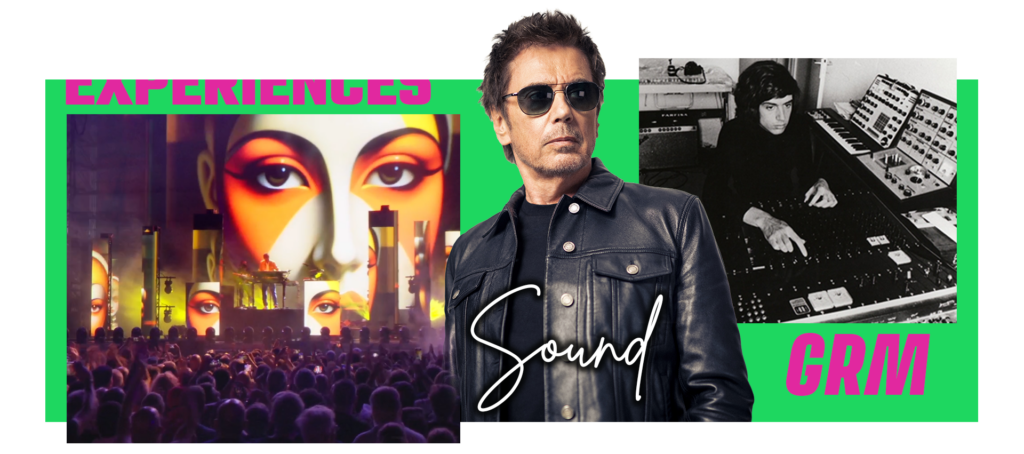
And she was there, she who had been waiting for their story to finally turn a corner. The machine never takes its eyes off the
“It is this way of breaking the rules that creates emotion. (…) If you always follow the rules, most of the time, you probably should not be an artist.”
And yet it is with quiet humility that he defines himself, or rather, that he refuses to define himself as an avant-garde figure, even as his vision helped carry electronic music toward the legitimacy it holds today.
“I think you never really know whether what you are doing may later become part of a movement. When you create, it is not necessarily about being nostalgic, nor even about trying to shape the future. That is not really my goal. What interests me more is exploring the present, harvesting it, understanding it.”
He would rather name those whom he considers the true pioneers, his mentors, as was the case with Pierre Schaeffer. An engineer at French public radio, Schaeffer took advantage of recording technologies to experiment with sound. He even coined the concept of the “sound object”, considering sound in its purest form, for what it is regardless of its source. Today, it is difficult to grasp just how radical these experiments were for music theory, especially when it came to blending so called “noise” with melody. Yet they were the first to dig the foundations of what electronic music would later become : “(…)a mix of technology, orchestral, acoustic and electric instruments.”
Today, every producer, every DJ, every musician who bends a noise, samples a fragment, or transforms an accidental texture into a rhythmic or atmospheric element is extending an idea that was once revolutionary: any sound can become music.
What the Machine Owes to Man
Jean Michel Jarre could not remain confined to this laboratory forever. Democratizing an experimental music made of synthesizers was no small task; at the time, it was almost a dare. He needed to reach people. He needed to say something. He had to go beyond sound itself and find a territory where the machine could finally speak to those who did not yet know it. The academic and scientific world of the GRM, as fertile as it was, felt too distant and elitist from what the machine was whispering to him. So Jarre made what seemed like a simple choice: to turn his back on music theory and embrace pratice instead. A decision that, without him knowing it yet, would help legitimize electronic music as a whole.
Jarre does not want melody to erase experimentation. Nor does he want experimentation to despise melody. He is looking for their point of contact.
He finds it first in cinema. In 1973, he composed the soundtrack for Les Granges brûlées.
“(…) soundtracks have of course played a major role in popularising electronic music. When I did my first film scores, I thought it was very interesting to use electronics not simply to illustrate the image, but to create a counterpoint, a dialogue with the visual. Tarantino or Christopher Nolan often say that music represents more than 50% of a film. I totally agree.”
This obsession with making the machine speak, with making it accessible without betraying it, would never leave him. It is already fully present when he begins to conceive what would become Oxygène. In 1976, the album was released into a world that was not expecting it. Eighteen million copies sold. A shockwave. But perhaps even more remarkable than its success is what it reveals about the artist himself: not a visionary obsessed with the future, but a man stubbornly rooted in the present.
“I have never been interested in nostalgia, nor in the idea of creating ‘the music of the future’. What interests me is music being part of the present, and gathering people.”
Behind the creator’s solitary obsession, and he does not hide it, “we are selfish, we are thieves”, there has always been another hunger, greater and more urgent than the creative impulse itself: sharing. Oxygène is not just an album. It is the first proof that the machine could say something so immediate, so contemporary, to the crowd. At the time, synthesizers were far from being considered legitimate instruments. But Jean Michel Jarre was ready to defend his soulmate with all his soul.
“At the time, these machines were rejected by the establishment, even by the rock or punk establishment. People would say: “What is this? It is not a real instrument.” For many people, an instrument was an electric guitar, drums or bass, but not a synthesizer. The synthesizer was not considered a credible musical item.”
There is, in Oxygène, all the mystery of the machine: a wordless music that nonetheless feels instantly understandable, syllabic, hypnotic and haunting. A music that does not seek to impose its modernity but simply breathes. Nothing is more recognizable than this strange and melodic cocktail that became the Jarre signature. A music fully rooted in presence, which would eventually impose itself on the world.
“Looking back, I realise that, without knowing it, I contributed to opening many doors: helping electronic music become a major genre around the world (…)”
That was his greatest obsession: building bridges between sounds that were never meant to meet. Like a mischievous child, always stepping outside the rules and resolutely anchored in the present:
“Actually, the idea of future is not part of the vocabulary of children, it is the vocabulary of adults. Adults are talking about modernity, of future, not children.(…)What interests me is the concept of the unique instant. Nothing is more important than the moment we share together, when we feel and share emotions.”
And perhaps that is what he remained throughout his life: a grown up child fascinated by the world, turning every moment into a spectacle. Side by side with his machines, he imagined extraordinary shows where music, visuals, architecture and staging constantly interacted. Monumental tableaux that travelled the globe, where the eye answers the ear and where sound can only become emotion.
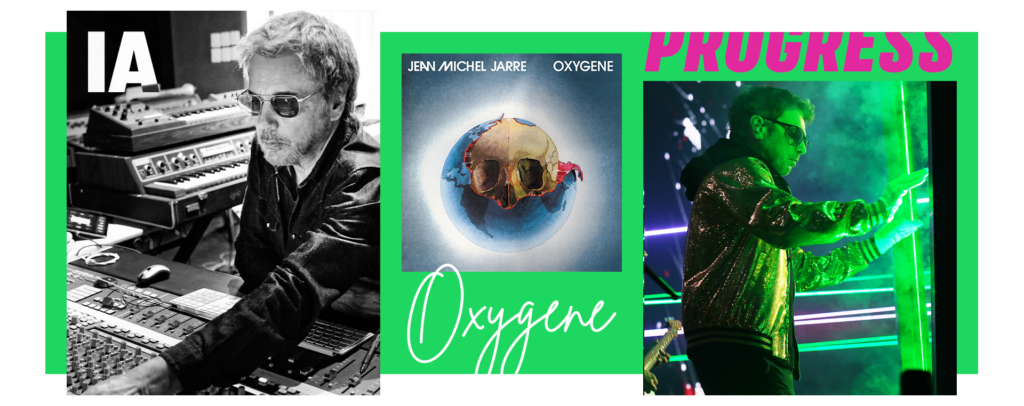
Augmented Imagination
There is also a fear that runs through the history of music like a red thread. At every era it wears a different face, and that fear is progress. Photography was going to kill painting. Cinema was going to kill the theatre. The synthesizer was going to kill orchestras, and Jarre remembers it precisely, having watched musicians from the Paris Opera unplug his system mid-concert, in a gesture of protest. It is always this deeply human fear of finding an intelligence that would surpass us. Today it is artificial intelligence. And Jarre, true to himself, embraces this new machine in his own way. He quotes his grandmother:
“As my grandmother used to say, we cannot stop progress. The earlier you embrace it, the better you will be able to explore it, exploit it, and eventually fight against its negative effects. (…) Augmented imagination. Amplified imagination. AI broadens the frontiers of my imagination.”
An expansion of the boundaries of the possible, a new muse for the artist, yet the same promise that second-hand tape recorder had made at eleven years old. The same invitation to discover a new object of curiosity. A conviction that the dialogue between man and tool is as old as humanity itself:
“The only music without an interface is the voice. As soon as you take a violin, a modular synthesizer or any instrument, you start a dialogue with technology. AI is another step.”
And like every step before it, it does not replace art,it transforms it, pushes it beyond the limits that we, ordinary mortals, can even imagine:
“Technology is always the catalyst for new art forms. AI will shape the new hip-hop, the new techno, the new electro of tomorrow, because the tools we use change the way we produce music.”
For those who fear that AI will drain creation of its meaning, that anyone can now generate music from a simple prompt, Jarre has an answer: the next Billie Eilish has nothing to fear. What makes an artist is not the tool. It is what he projects onto it, the intention, that unique and irreducible way of inhabiting the world in order to say something. Some find contemporary art ridiculous: standing before a Soulages, a monochrome canvas, pure black, the reaction is often the same, I could do that too. Perhaps. But to say what?
That is what Jarre has always embodied, not only a man capable of speaking to machines and making them more beautiful, but an artist who has something to say through them. AI will never change the sincerity of the dialogue he finds with the machine. It will simply be there to whisper unique performances in his ear:
“Electronic music is more based on a shared concept: the important thing is not only the performer, but the performance.”
For Amnesia, he is already working with it. A new machine that takes its place in the bed of the others, without displacing any of them. Jarre has never been a man of a single muse. What fills him with wonder is both the power of the tool and the freedom it offers him:
“What is fantastic today is that technology allows me to do what I want. For Amnesia, I am working a lot with AI on the stage design. I design the whole scenography myself, which would have been impossible ten or fifteen years ago. Today, from my bedroom, I can create my stage design, just as I can create my music thanks to computers.”
The entire scenography of the show, conceived as an extension of the music, is the dialogue he never ceased to seek, an ephemeral architecture that invades space. And this is nothing new for him: incorporating the space in which he performs into his visual tableau has always been part of the work.
We remember of course his performance at the Forbidden City, or in Moscow for the largest concert in the history of live music. The idea becomes clearer, this almost philosophical conception of leaving a mark and then departing as if it had never existed. A profoundly metaphysical vision of a parallel reality, for one night, in any place willing to let him speak. Behind these immense shows that marked history, there is a childhood memory:
“That probably comes from my childhood. In front of my grandparents’ apartment, there was a large square where a circus would come and set up. I was fascinated by those people arriving, building the big top, performing their show, and then disappearing the next morning. There is something romantic in that idea of performance, and I try to reproduce it with modern technologies.”
One Night Only in Amnesia
There are meetings that destiny takes its time to arrange. The one between Jarre and Amnesia is one of them. As if all these years had to pass for the legendary venue and the founding artist to finally meet, in this era and not another, for this show and not another, one that will never be repeated.
“I am happy to have kept a kind of virginity in terms of performing in Ibiza, in order to celebrate Amnesia’s 50th anniversary. Amnesia is the place where everything started for dance music. It is a legend.”
This show will never be the one at the Forbidden City. Never the one in Moscow. Never Houston. It will be only itself, irreplaceable because irreducible to everything that came before it, and to the moment in which it takes place.
“What I am going to create at Amnesia cannot be experienced again in exactly the same way the following Saturday. What interests me as an artistic form is to take over a place for one night, and then disappear.”
On the 5th of July, Jarre will illuminate the island at the very heart of what represents it most. A bacchic night, intoxicated, with his machines as muses. The perfect alignment of the stars, that of the club, that of Oxygène, that of a man who will have waited for exactly the right moment to play in exactly the right place. And then disappear.
Coda
In the end, there will always be Jean-Michel Jarre. And his Machines.
Tickets for Jean-Michel Jarre concert at Amnesia Ibiza are available here.
📷 : Cover Photo Credits / Courtesy of Jean Michel Jarre
📷 : Additional Photo Credits / Courtesy of Jean Michel Jarre