
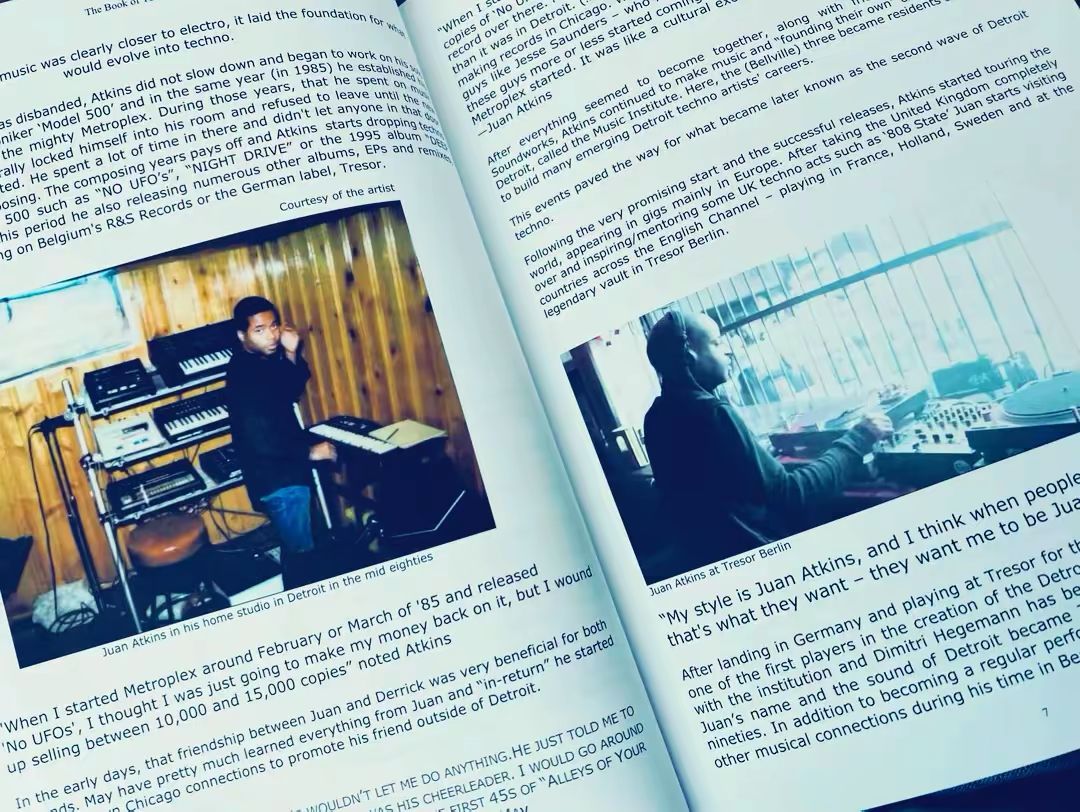
In 2026, techno is everywhere and often nowhere at once.Yes we know, things have changed, techno is moving to something nobody can really understand. The word gets used for almost anything with a hard kick, its imagery is endlessly recycled, and its culture is increasingly absorbed into trends. So what remains when a living scene starts to lose touch with its own history?

Memory Matters
For the author of The Book of Techno, Mark Petes Varga, the answer with his research is : memory matters. “One of the main purposes of my book is to help people gain a better understanding of this genre,” he explains, insisting that techno is not just party music, but a cultural movement spanning generations.
Techno is now far removed from its marginal past. it is booming, becoming a fully fledged cultural industry after having long been dismissed. But which techno is being recognised today? The kind that works, the kind that is not really what it claims to be a techno emptied of its essence, stripped of its substance. It is precisely that volatile substance that The Book of Techno seeks to bring back into the spotlight. Nothing is ever just music, everything inevitably becomes narrative.
“Techno is the most complex multi layered and diverse electronic music genre of all, a cultural movement spanning generations that cannot be simply described as banging sound. Here, readers can learn about the birth of the movement, what motivated the creators and what perspectives this genre has achieved worldwide.”
Behind this approach, there is also a strictly musical intention: what techno is, and what it is not :
“(…) nowadays, even most fans are not aware of it and they are calling every existing electronic genre techno, which is really unfortunate.” In that sense the book of techno reacts against a moment in which younger audiences “are labelling Hardstyle, Psytrance and other genre as techno,” while “many ‘DJs’ calling themselves techno but playing whatever is trending at moment and has nothing to do with techno.“
This frustration is framed as a concern for what gets erased when history is flattened “We are losing the culture” he assumes plainly. If techno becomes an umbrella term for everything and anything, then what disappears is not just genre precision. What disappears is a whole network of contexts, of ideas, places, struggles and sonic identities that made techno what it is in the first place.

Rebuilding techno through places: Detroit, Berlin, Ibiza, rave culture and the pioneers
If the book’s first task is an act of rebellion against the genre’s transformations, its main one is to map out the history of techno. Detroit remains central, but it is placed back within a broader geography of circulation, influence and transformation:
“Spanish club culture is the part of the third chapter which deals with the Story of Rave Culture and without the La Ruta del Bakalao or Ibiza it would not be possible to tell the full story because countries and nations have influenced each other at the time very much.”
The choice to begin this cartography in the late 1960s rather than in the 1980s follows the same logic. For him, even though de Godfathers of the genre had no intention to copy others artists, they have been influenced by others even unconsciously. That’s why the author highlights the major role the German group Kraftwerk played in the creation of techno.
And with accuracy : in a French article for Le Grand Continent, musician Bernard Sumner recalls the major influence of the German group on the identity of electronic music in Europe:“Kraftwerk is unique; I don’t think this group could have emerged anywhere other than in Europe […]. Kraftwerk and krautrock bands such as Can and Neu! (…) played a fundamental role in the musical earthquake that marked the transition from American guitars to a new, synthetic, and distinctly European sound.”Detroit is a major place, yes, but we’ve all forgotten that the first early days of electronic music come from Europe. This desire to widen the frame and to open it up to influences is precisely what allows the book to maintain coherence and credibility in its intention:
“I wanted to share a comprehensive piece on this subject which must include pioneers and major happenings from all over the world.”
Voices
Artists and pioneers are at the heart of The Book of Techno, their voices and experiences were foundational to the writing of the book, allowing it to be not just a book on paper, but a living one: “Without them, techno we know today, would not be the same.” He also acknowledges the impossibility of being exhaustive: “unfortunately it is impossible to introduce every worthy musician in detail because the space of 10 books would not be enough.” Even so, he selects a wide range of defining names : “Richie Hawtin, Miss Djax, Octave One, Eddie Fowlkes, Monika Kruse, K-Hand, Dr. Motte, Dave Clarke, Ben Sims, Chris Liebing, Sven Väth, Laurent Garnier or Speedy J”, not to build a hall of fame we already know too well, but to remind us that the evolution of techno has been collective, transnational and above all cumulative.

Inside the culture, for the culture
What gives weight to this historical ambition is the way the book was documented. For any researcher, whatever the field, what gives a work its credibility is its sources: “The vast majority of the information comes from, official sources: tons of interviews, articles, documentaries, from journalists, and from the artists themselves and their management, club – festival and label owners, so we can say that, this is all a first-hand historical informations.”
The list of people and institutions involved in the process gives a sense of that scale. “I corresponded a lot with Rocco Veenboer, the father of Awakenings,” he explains. He also mentions Dimitri Hegemann, the owner of the oldest and most respected institution of Tresor, as well as the management of CLR – Richie Hawtin – Sven Väth or Dr. Motte, who also helped him in the writing process by giving him the kind of information that only those who were part of this larger history could tell. For the first chapter on Detroit, he exchanges with Cornelius Harris, meets Mad Mike Banks, and secures permission to use photographs and content linked to foundational figures such as Juan Atkins, Derrick May, Carl Craig and Robert Hood.
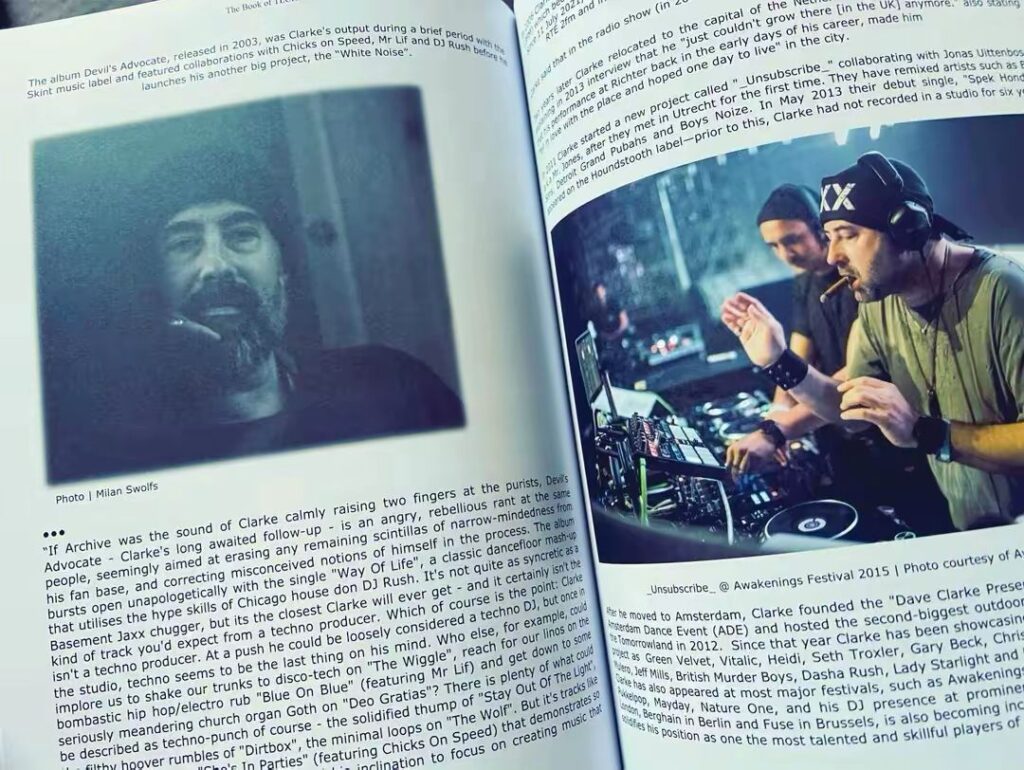
What emerges from all this is a book written in close proximity not only to archives and published material, but also to the people who embody the movement’s history. This method is inseparable from Marl Petes Vergas’s own position within the culture. “I have been an enthusiastic member and follower of techno culture for over 20 years now and during this time I have learned & developed a lot myself as a partygoer.” This does not replace research, of course, but it deepens it. The book is nourished both by documentation and by long-term immersion. It is written by someone who does not speak about techno from the outside, but who seeks to honour a culture he has lived with and within.
If the book’s ambition is to preserve and transmit techno culture, its reception suggests that this ambition has resonated with people, artists, passionate fans, and perhaps also those still discovering it:
“Since the publishing, I have received an overwhelming amount of support from techno fans and legendary artists from all over the world. I can proudly say that The Book of Techno is gaining global recognition at every imaginable level.”
What to take away
In many ways, The Book of Techno reminds us that, in becoming more visible, techno has also become more exposed to smoothing, simplification, and the loss of substance and history. The book presents itself as a tribute, because it reminds us that a culture is not saved by its success alone, but by the memory it preserves of its marginal side, its origins, its tensions, and what it once refused to become.
“If this publication has enriched the life of even one person, then it’s definitely worth it because it was never about money, but for the culture.”
📷 : Cover Photo Credits / Mark Petes Varga, The book of Techno
📷 : Additional Photo Credits / Mark Petes Varga, The book of Techno
Get the book here : https://amzn.to/4uf1pUO