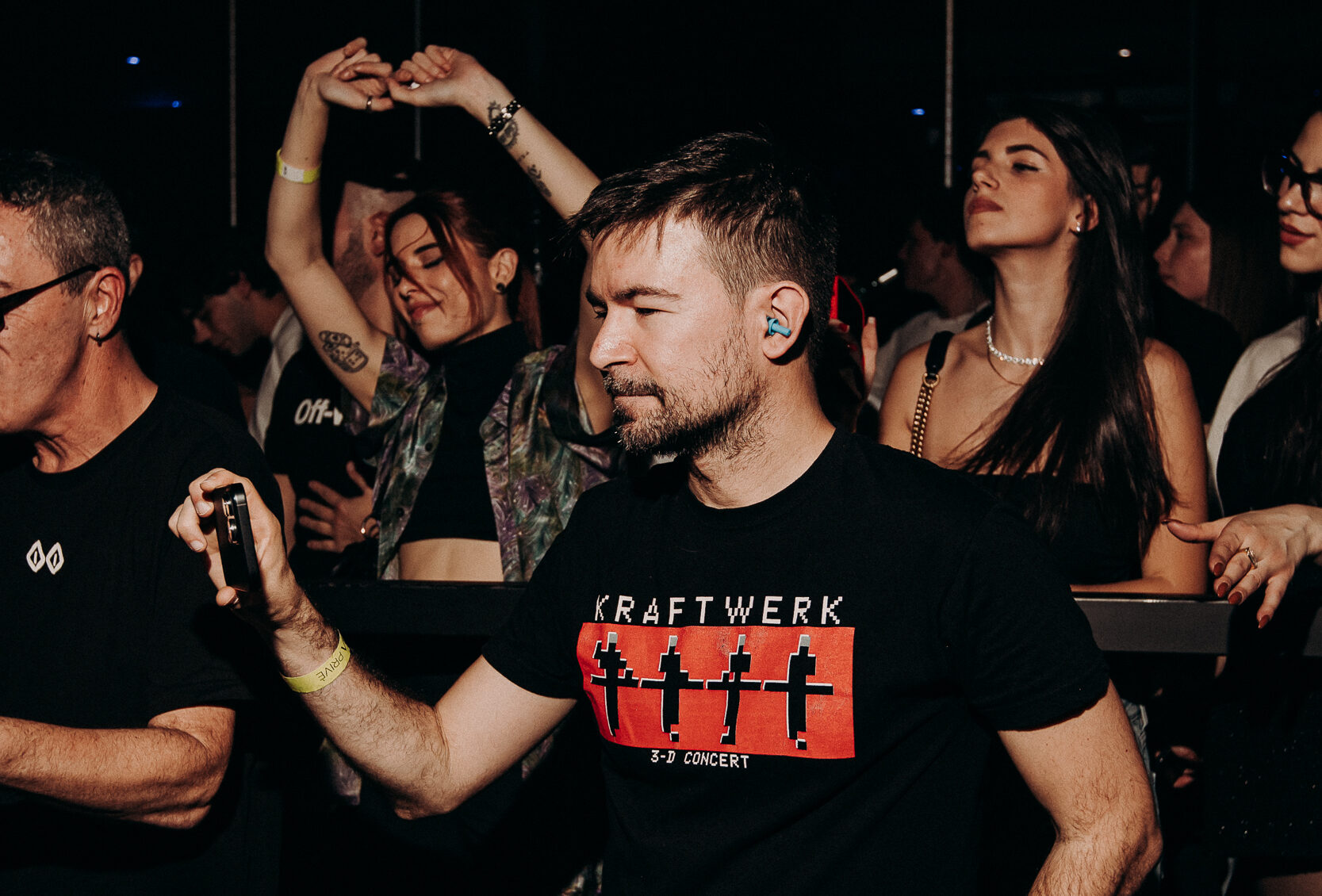
Long before filming yourself at parties became a kind of fame, he was already archiving his nights, his joy, his memories. Not just DJs and lights, but above all, those flashes of collective euphoria. Resourceful and driven by a brightness that never seems to leave him, we wanted to know more. Luca Dea answered us, with humor and that same obsession: letting nothing disappear. Get comfortable, because we’re pressing play on the VHS.
Enjoy the silence
“Especially before a party, I love to relax and enjoy hours of silence :).” Nothing surprising, really, when you live at night, to need a decompression chamber far from the bass that makes your ribcage vibrate (and above all, your heart). For most of us, it’s hard to picture such a routine. Luca is a bit like a pilgrim, driven by an insatiable goal: capturing the night. It’s a mission that has become his job, so breathing has turned into a necessity.
And then, in the morning, he gets back to work. He plugs in, sorts, opens files, replays sequences, listens to the same clips until he knows them by heart. “In the morning, however, I love getting to work, uploading the first videos and listening to them over and over again.” Filming, then, isn’t just about capturing a moment, it’s also about extending it. Coming back. Watching again. Saving from oblivion what would otherwise fade at the same pace as the night itself.
Luca doesn’t film to prove he “was there.” His aim comes from something more personal: the curiosity of the day after, the desire to relive the moment through sound and image, like choosing to reopen a travel journal.And above all, he insists on something that flips today’s social media logic on its head: his videos start for him, and only then do they become for others.
“For me, every video has always been made for myself; I’ve always been my own first “customer.”
And even if everything begins with him, what he’s doing is archiving precious moments of humanity and sometimes, you have to say it, it warms your heart.
But this relationship with the morning after doesn’t come from partying: it was already there, long before the clubs.
VHS
For Luca Dea, the taste for tangible memories didn’t begin in a party, or even with friends. It starts in a living room, with his grandfather pressing rec to record a football match while Luca was asleep. You can already see the nostalgia and the joy that drive him, rooted in childhood. Luca keeps coming back to passion, passed down by his grandparents:
“Before the nightlife, I was always a person who loved to be passionate. Among my greatest passions, I have always been into football, geography, and animals. I’ve always dreamed of working in football, travel, or something with animals. I still dream of doing something that combines all three. I was curious about and learned about many things, thanks in large part to my maternal grandparents, who encouraged me to pursue multiple interests, for example, my grandfather used to record VHS tapesof football matches that I couldn’t watch because I went to bed early and my grandmother helped me a lot with my creativity”
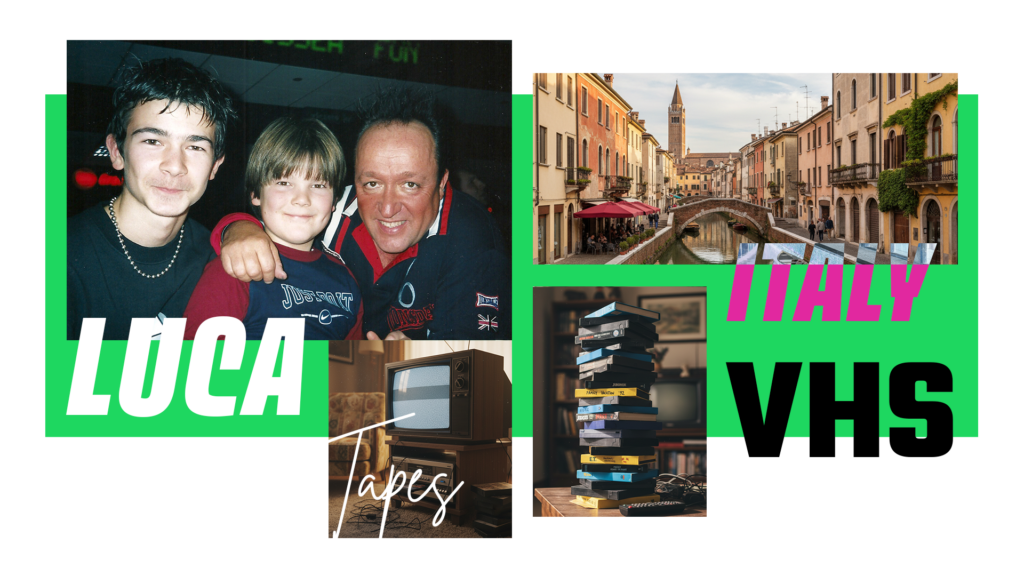
Then Luca loses his grandfather at ten, his grandmother at fourteen. And he chooses to honor them. Instead of closing the doors on that creativity, he opens them wider, as if throwing himself into his passions was a way of staying close to them, letting the seeds of ideas they had planted keep growing, the legacy they left behind.
“When I lost them—my grandfather when I was 10, my grandmother when I was 14—I continued and perhaps increased my interest in my passions, almost unconsciously to keep their memory alive.”
Filming, keeping, replaying, none of it is a gadget for him. It’s also a way of standing upright in time. “I love having memories in every moment of my life, perhaps because they subconsciously keep me alive with the memory of my grandparents.”
After VHS, a shift in scale becomes inevitable. Luca leaves the living room behind and steps into an adolescence paced by television, music videos, downloads (nostalgia, when you hold us). Before filming parties, Luca was already a serious collector. Always ready to put on his playlist!
CD Walkman
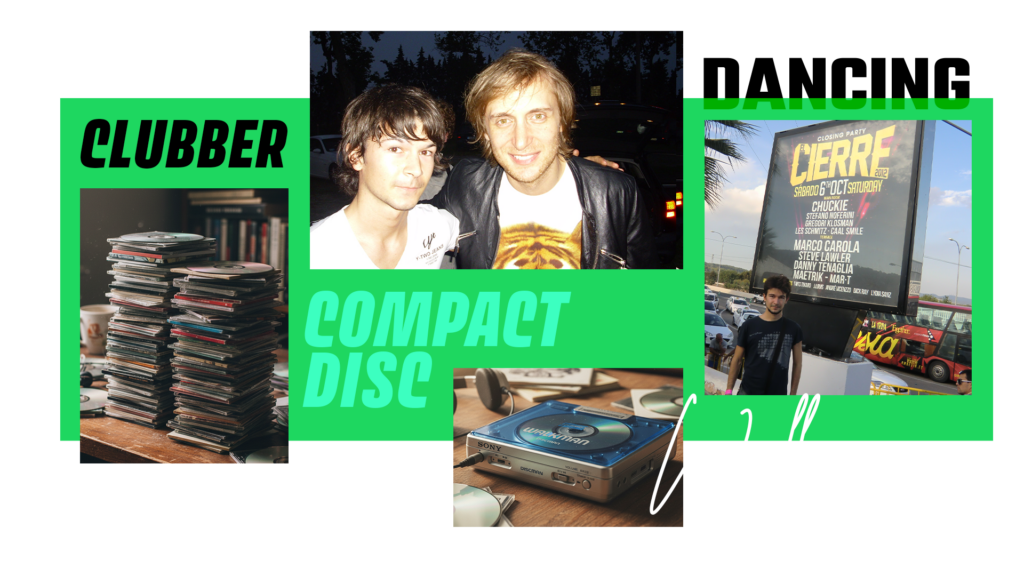
Before platforms, before feeds and algorithms that do the discovering “for you”, there was another school: television. A generation that learned music by watching music videos. Luca remembers his teenage years as a long, happy channel-surfing session, the beginning of a digital culture built in front of the small screen: “I remember my teenage years (2003-2007) with great pleasure. I spent hours and hours watching music channels, I loved watching music videos on MTV to discover new songs…”
And then there’s the material side of an entire era, the CD as an object, the early 2000s. You stack them, swap them, burn them, sort them. And when money is tight, you find a way: “…I bought tons of CDs, and when I couldn’t, I downloaded from eMule and Limewire.” It says a lot about his active relationship to music, that of a curator.
At parties with friends, Luca never showed up empty-handed. He came with his selection to get everyone on the same wavelength: “At my first parties with friends, I remember loving arriving with my CDs and put my favorite songs! From pop to rap, and also electronic music.”And he insists on one important detail: what he loved was selecting: “I really enjoyed being the one who selected the music at the first parties with friends, I underline selecting…”
Hard Drive
Ultimately, that finely tuned sense of selection led him into nightlife, because before Luca became a content creator, he was first and foremost a clubber, a partygoer and how could he not be, at a time when club culture was at its peak. Luca remembers the first night he filmed an artist: “I remember it well, yes, I was in a party in my hometown Treviso 🙂 one of the first videos of a big artist I did was in 2007: Stephan Bodzin Live!”
The enthusiasm with which he tells that first memory almost makes you want to go back there:
“For me, recording moments of happiness was already part of me even before going to parties, especially taking simple photos, and videos were a consequence. Just to have a memory of images, but above all audio, of the music and voices.”
Filming in the late 2000s was nothing like the automatic reflex it is today. It was DIY, fragile, imperfect but that’s probably exactly what gives all the charm to what we managed to keep: “In the first years it was very difficult to save memories, the quality of pics and videos from the phone was really bad comparing to now” with a setup that feels old-school today:
“I recorded many of my first videos between 2007 and 2009 with a small camera that mainly took photos, but also had a video mode. In 2009, I got a small Samsung camera to only shoot videos for 200 euros 🙂 then in 2011 before going to Off Sonar I bought one for 500 euro”
There was also pressure from the venues. Many clubs banned cameras back then compared to today. So you had to stay discreet, almost invisible. Keep going even when you felt out of step with a whole generation partying behind closed doors.
“However, when I started going to bigger parties, yes I often felt nervous in the first few years because in some places it was forbidden to take videos with a camera, and I often hid it to carry it with me. (…) “Making videos was definitely not “trendy.” Those years (2007-2012)”
He also tells us about the best night of his life from those years, without even needing to look at the footage everything is in his head:
“The first time I heard Sven Vath, in February 2008, I was 18. Some older friends of mine took me to Mazoom Le Plaisir, in Italy. We hung out in the parking lot for a drink, and then when we entered the club, it was an incredible musical journey with the minimal techno of the era… Lucio Aquilina’s “Magic M” is the most beautiful track I remember from that night. What a night!”
If Luca knows the dancefloor inside out, he also learns the backstage quickly. Among the many jobs he’s done, Luca worked as a PR. He had to find that delicate balance when you work in a festive environment, having fun is obviously part of the job, but knowing when to stop is part of it too: “From the very beginning, I’ve always seen parties as a place for fun but also a serious place, having been a PR person since the very beginning. I attended meetings and had office meetings with the owners, so my mood was to party and drink, but not too much. I liked to maintain a professional attitude.”
He even went on to produce events himself. A fast-track education, full scale. And a very concrete way to fund the next step leaving the local scene, thinking bigger, and figuring out what he truly wanted to do:
“I even organized parties myself with partners, student parties for 3,000 people between 2009 and 2011, and these helped me save up enough money to go to the first festivals, where I realized that what I wanted to do was make videos.”
From 2011 on, Luca started to build a name for himself:
“In fact, since 2011 I gave up being a PR or organizing parties and started making videos just for fun, but already in a short time some events started calling me, so I divided my time between the local events that called me and the international ones where I went to make myself known but above all to get to know new realities.”
Then in 2021, he shifted scale. Video became a performance in itself. He was no longer booked only to document, but to be part of the event:
“It became really serious from 2021, when I joined a DJ booking agency, they started selling me as an artist to events with same method they sell a DJ, the only difference is my type of performance, that is promoting the event before, join the event and doing my videos there, something also with long streaming, interacting with people that are not there, and then promoting the next event with uploading the best moments of the event just finished”
It’s a genuinely interesting trajectory, because Luca was in many ways ahead of his time. He positioned himself on social media long before it took on the gatekeeper role it has today. Without realizing it, Luca was the reporter of tomorrow and that’s probably what built his success. For many people, he is a reference, the first to do it. It’s hard to imagine now, but back then you didn’t know what was happening in clubs, nothing was filmed or broadcast on social media. The passion he followed, almost innocently, was never superficial. It required seeing what was coming, the rise of the digital world, the takeover of social media, and he saw it early.
Deep down, what he has preserved on his hard drive speaks for those who live. Behind what can look like “look at me,” there is a collective memory, a cultural memory far more essential than we might think.
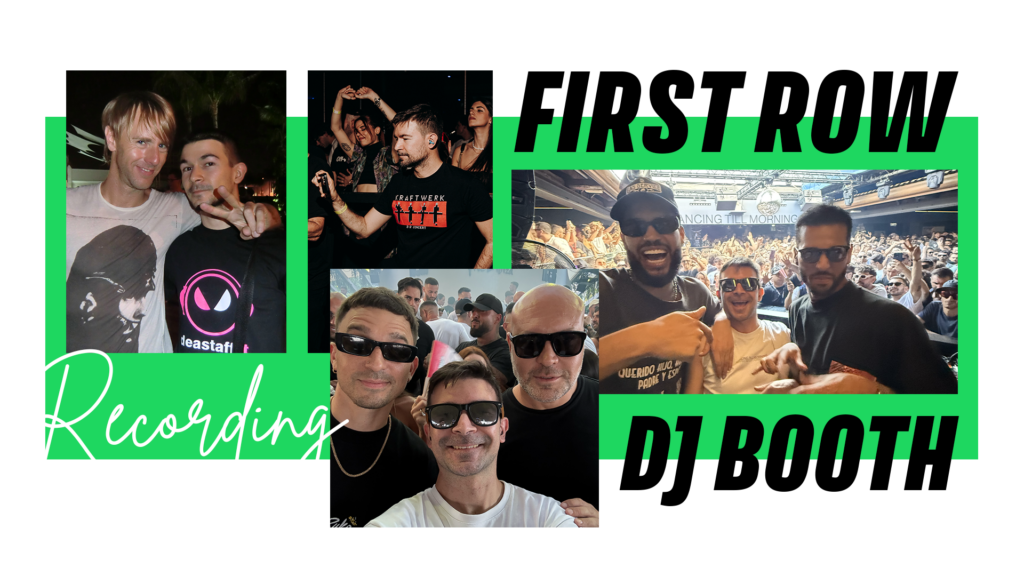
Firt Row
Still driven by the same obsession, catching joy when it moves through people, Luca describes the night as a crowd to observe. What draws him in, what never bores him, can be summed up in one sentence: “Dancing and watching different people having fun together—that will never bore me.”
When he arrives at a party, he “reads” the room. He starts by joking, then he lays out, very seriously, his criteria for a club that works. “The girls, haha, no seriously, an ideal club that works, for me, should have an approximately equal number of girls and boys. When I see a disproportionate number of boys compared to girls, I feel like something’s wrong. Something also important Is obviously to see people dancing in the first row, I love when you receive good vibes from the first row with people dancing and jumping”
For him, the front row is a thermometer. It sets the tone, gives permission to let go, and spreads through the rest of the room. And that’s exactly where he places himself: “I’m part of the audience, I’ll always be part of the audience, who has the opportunity to be close to the DJs.”
That closeness to artists, Luca experiences as a privilege. Because it gives him access to a space not everyone can enter: the DJ booth. Filming a DJ from just a few centimeters away, documenting their work, comes with rules to respect:
“showing respect and following their directions, for the common good and for clubbing in general.” (…) “There are many things to be careful about, certainly understanding the distance to stand from a DJ. There are DJs who like to be filmed up close, while others prefer to be filmed from further away. I always try to understand this and do my best to make great videos.”
That rigor also extends to what he chooses to capture and especially to what he refuses to show to an audience he is part of. “I don’t film anything I don’t like, because, as I always say, I’m the first customer of my videos.”
In the end, the only “lesson” he really draws from all those years chasing the party is the simplest one: “(…) wanting to dance is ageless :)”
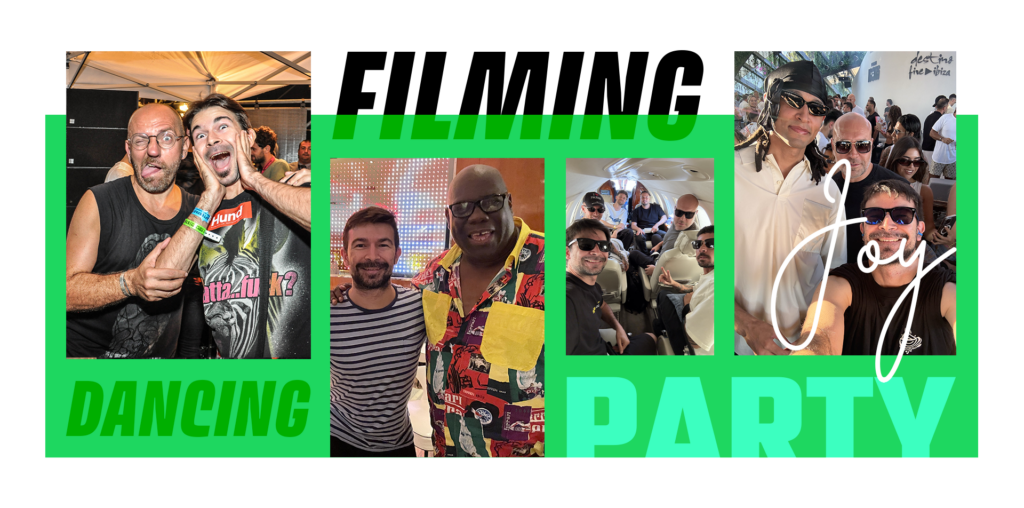
Upload
The day after the euphoria, when silence returns, Luca finds himself facing what he recorded. He watches, he listens again as if those images were a kind of loot, and in a way, a victory over oblivion.
Except that an archive is never guaranteed. It can vanish in an instant, without warning. And “files” that disappear, it’s entire nights you’ll never be able to piece back together.
“In September 2013 I lost the entire summer of 2013. A new hard drive I’d just bought fell and couldn’t be fixed… luckily, the best videos from that summer had already been uploaded to YouTube, but still, many videos and, above all, many photos were lost… this makes me feel really bad, but we have to move on, and think that the best memories I have to create are still there, in the years to come.”
Despite the mistakes and the hard drives hitting the floor, Luca keeps recording joy even if he’s already thought about stopping. Not for lack of interest, but because this pace comes at a cost, and time isn’t elastic. “I have always been convinced that I had time, but now I realize that the time we have is increasingly limited, so now I try more and more not to waste too much energy and concentrate on what I can enhance most.” but “(his) passion for music has always brought (him) back”
What he fears now goes beyond his own journey, the idea that the party could become a stage to prove yourself on rather than a place to live, that people might come to film instead of gathering and dancing together. “I’m scared that people might stop getting together to go dancing… but only to go and make videos to show they were there.”
In any case, for him, what the party represents still does and always will be: “Culture, inclusion, sharing.”
Discover more about LUCA DEA
📷 : Cover Photo Credits / Courtesy of Luca Dea
📷 : Additional Photo Credits / Courtesy of Luca Dea
💚: Special thanks to @luca_dea_official